10 Effective Ways to Save Money with 10 Easy-to-Apply Tips
30/10/2026
A summary of 10 effective and easy-to-apply ways to save money for different income levels: setting goals, the 50/30/20 rule, the 6 Jars method, an emergency fund, and online savings.
Having a higher income but still having nothing left at the end of the month is quite common today. The reason often lies not in how much you earn, but in how you manage your cash flow every day. The article below summarizes 10 effective and easy-to-apply ways to save money for different income levels, from budgeting and controlling expenses to saving money at a bank so your funds can grow safely and sustainably.
Note: The figures and information in this article are compiled from general market sources and do not apply exclusively to SeABank's products.
1. Why Should You Learn How to Save Money Early?
Saving is not simply about "putting money aside" but serves as a foundation that helps you become more proactive when facing changes in life. A consistent saving habit provides many practical benefits:
Be prepared for unexpected events: An emergency fund helps you deal with unexpected situations such as illness, job loss, home repairs, etc. without having to borrow money.
Achieve major goals: Buying a home, buying a car, studying, getting married, or traveling all require savings accumulated over a long period.
Reduce debt pressure: When you already have savings, you are less dependent on consumer loans and can avoid additional borrowing costs.
Take advantage of compound interest: Term deposits that are renewed with both principal and interest continue to earn interest on previously earned interest. The earlier you start, the more time your savings have to grow.
Create greater peace of mind: A stable financial foundation helps you feel more confident when making decisions about work and life.
2. 10 Effective and Easy-to-Apply Ways to Save Money
There is no single formula that works for everyone, but the methods below have been successfully applied by many people and can be flexibly adjusted to suit your circumstances.
2.1. Set Specific Savings Goals
A clear goal will motivate you to maintain spending discipline. Instead of setting a general goal such as "save more," make it specific based on the following criteria:
Amount needed: For example, 60,000,000 VND for an emergency fund.
Completion period: For example, within 12 months.
Amount to save each month: Divide the total amount by the number of months, for example, 5,000,000 VND/month.
You should divide your goals into short-term (under 1 year), medium-term (1 - 5 years), and long-term (over 5 years) goals to choose the most suitable saving method for each objective.
2.2. Record and Track Daily Expenses
You cannot save effectively if you do not know where your money is going. Record all expenses for around 1 - 2 months to identify your spending habits:
Group expenses: Food, transportation, housing, shopping, entertainment, education, etc.
Mark unnecessary expenses: Expenses arising from impulse purchases or items that can be reduced.
Review at the end of the month: Compare actual spending with your original plan and make adjustments for the following month.
Cashless payments through banking apps also make tracking easier because every transaction is recorded in your account history.
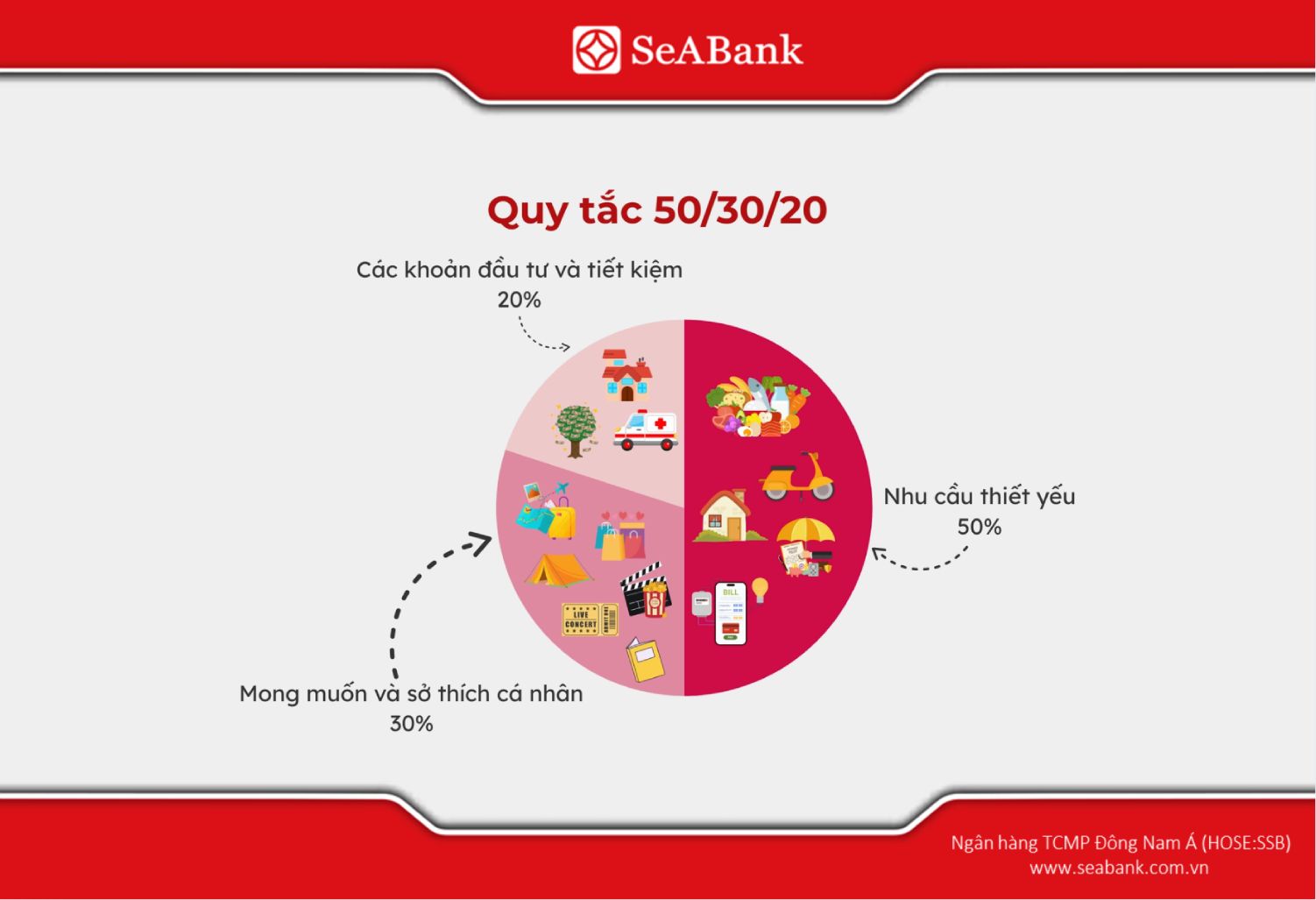
2.3. How to Save Your Salary Effectively: Apply the 50/30/20 Spending Rule
If you are looking to learn how to save your salary, this is a simple income allocation method suitable for people who are new to personal financial management:
50% for essential needs: Housing, utilities, food, transportation, insurance, etc.
30% for personal wants: Shopping, entertainment, dining out, travel, etc.
20% for savings and debt repayment: Savings deposits, building an emergency fund, or repaying loans.
For example, with a monthly income of 15,000,000 VND, you can allocate approximately 7,500,000 VND to essential needs, 4,500,000 VND to personal wants, and 3,000,000 VND to savings. These ratios can be adjusted depending on the cost of living where you live.
Applying the 50/30/20 spending rule
2.4. Manage Money Using the 6 Jars Method
The 6 Jars method divides your income into 6 separate funds with different purposes:
Essential needs (55%): Daily living expenses.
Long-term savings (10%): For major future goals.
Education (10%): Investment in learning and personal development.
Enjoyment (10%): Entertainment, travel, and self-care.
Financial freedom (10%): Money used for investment and generating additional income.
Giving (5%): Supporting family, friends, or charitable activities.
If you do not want to track expenses manually, you can refer to the Financial Health feature on SeABank's SeAMobile app. The app supports transaction and spending tracking and analysis based on the 6 Jars model, spending reminders, savings suggestions, and allows you to create and manage financial goals.
2.5. Pay Yourself First
Instead of "spending first and saving what is left," do the opposite: Set aside a fixed amount for savings as soon as you receive your salary, then spend the remaining amount. This approach makes saving a priority rather than depending on whatever is left at the end of the month.
To maintain consistency, you can set a reminder for your payday or separate a dedicated account used only for savings.
2.6. Cut "Leaky" Expenses
Small recurring daily expenses are often overlooked but can account for a significant portion of your budget:
Review subscriptions: Cancel movie, music, or paid app subscriptions that you rarely use.
Limit dining out and ordering drinks: Cooking at home and bringing lunch to work can help you save significantly each month.
Make a list before going to the market or supermarket: Buy only what you need and avoid impulse purchases.
Save electricity and water: Turn off appliances when not in use and prioritize products with energy-saving labels.
2.7. Apply a Waiting Rule Before Making Purchases
Emotional spending is one of the common reasons budgets are exceeded. You can apply a waiting rule:
For lower-value items: Wait around 24 - 48 hours before deciding to buy.
For higher-value items: Wait around 30 days and reconsider whether you really need them.
After the waiting period, if you still feel that the item is truly necessary and fits within your budget, you can buy it. In many cases, the initial desire gradually fades and you are able to keep the money.
2.8. Build an Emergency Fund
An emergency fund serves as a "financial cushion" that helps you avoid withdrawing long-term savings or taking on debt when unexpected problems arise. Many financial experts generally recommend that an emergency fund be equivalent to around 3 - 6 months of living expenses.
This money should be highly liquid, so you can consider demand deposits or short-term savings deposits to ensure easy access when needed while still earning some interest.
2.9. Control Debt and Use Credit Cards with a Plan
High-interest debt can "erode" your savings progress. To manage debt more effectively:
Prioritize paying off high-interest debt first: Reduce the total interest cost paid over time.
Make payments on time: Avoid late payment fees and negative impacts on your credit history.
Use credit cards as a payment tool: Only spend within your repayment capacity and pay the full outstanding balance before the due date to avoid interest charges.
You should learn how to control debt and use credit cards with a plan
2.10. Save Money to Earn Stable Returns
Keeping idle funds in your wallet or payment account makes it easier to spend them and causes you to miss opportunities to earn returns. Bank savings are suitable for those who prioritize safety and stability:
Term savings: Suitable for funds that will remain idle for a specific period.
Recurring savings (accumulation savings): Suitable for those who want to start with a small amount and contribute regularly according to a plan.
Online savings: Quickly open a savings account through a digital banking app, with online deposit rates at many banks often offering better incentives than deposits made at a transaction counter.
3. Saving Methods Suitable for Different Groups
Each stage of life comes with different financial priorities. Below are some suggestions for your reference.
3.1. Students
Take advantage of student discounts: Bus fares, gym memberships, learning software, etc.
Limit trend-driven spending: Think carefully before buying clothes or new technology devices.
Start with small amounts: Set aside part of your allowance or monthly part-time income to build the habit of saving.
3.2. New Employees
Create a budget from your first salary: Apply the 50/30/20 rule or the 6 Jars method to allocate income. This is a simple way to learn how to save your salary as soon as you start working.
Prioritize building an emergency fund: Before considering higher-risk investments.
Avoid "lifestyle inflation": When your income increases, increase your savings rate instead of increasing spending at the same pace.
3.3. Families with Young Children
Create a shared spending plan: List fixed expenses such as tuition fees, milk, diapers, healthcare, etc. to manage the budget proactively.
Shop smart: Take advantage of promotions and buy essential goods in reasonable quantities.
Build long-term savings for your child: Start preparing an education fund early through recurring savings products. At SeABank, the "Nurturing Dreams" recurring savings product for children allows deposits from 200,000 VND per contribution, with flexible deposit amounts and timing.
Each group should choose a saving method that matches its income and individual goals.
4. Guide to Online Savings on the SeAMobile App
Online savings helps you proactively build savings without visiting a transaction counter and is suitable for today's busy lifestyle.
4.1. Benefits of Online Savings
Proactive anytime, anywhere: Deposit money, monitor balances, settle, or renew savings accounts directly on your phone.
Simple procedures: No physical paperwork is required, and transactions can be completed within a few minutes.
Multi-layer security: Transactions are authenticated using methods such as biometrics (Face ID/fingerprint) combined with OTP.
Transparent management: Easily monitor interest earnings and the maturity date of each savings deposit.
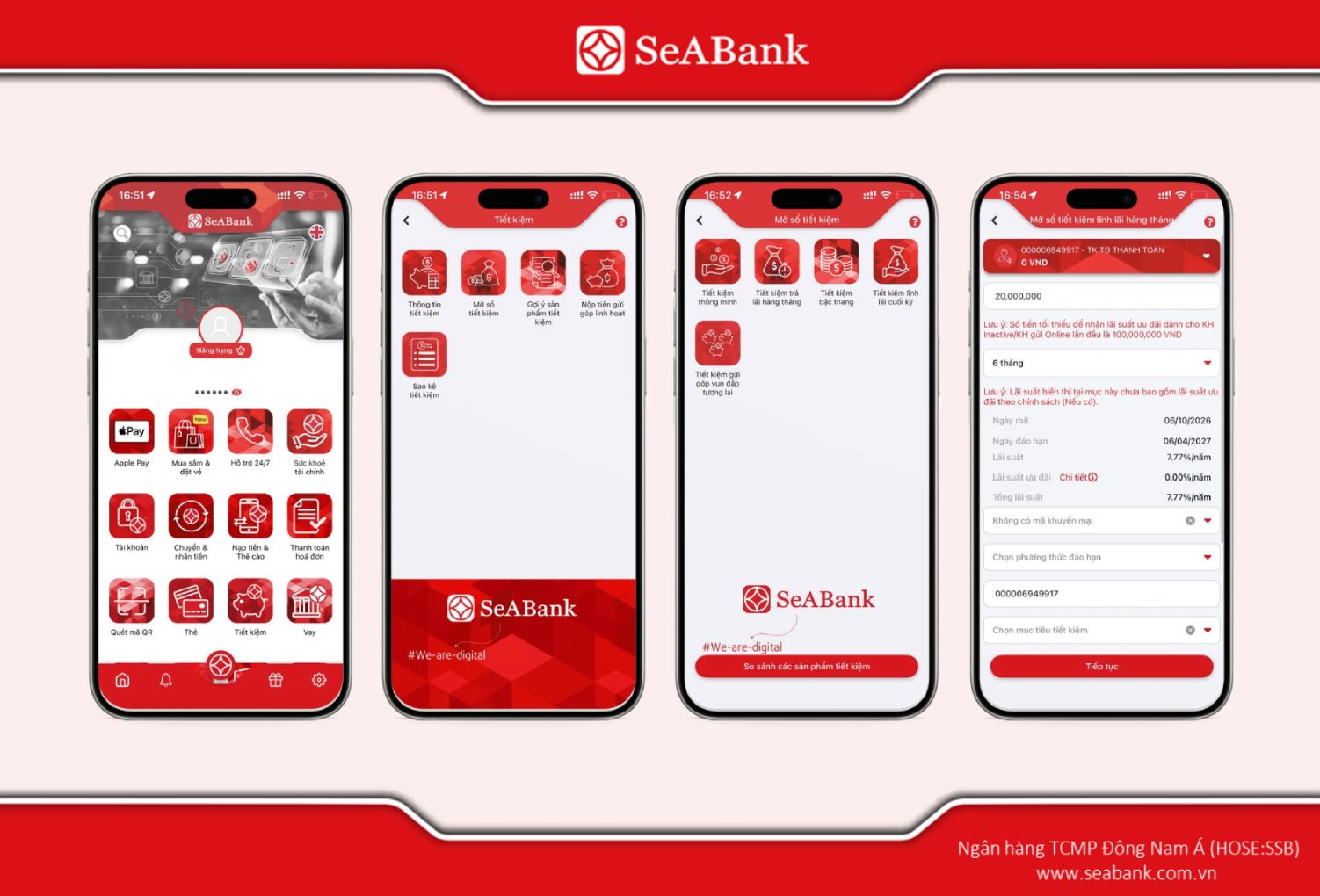
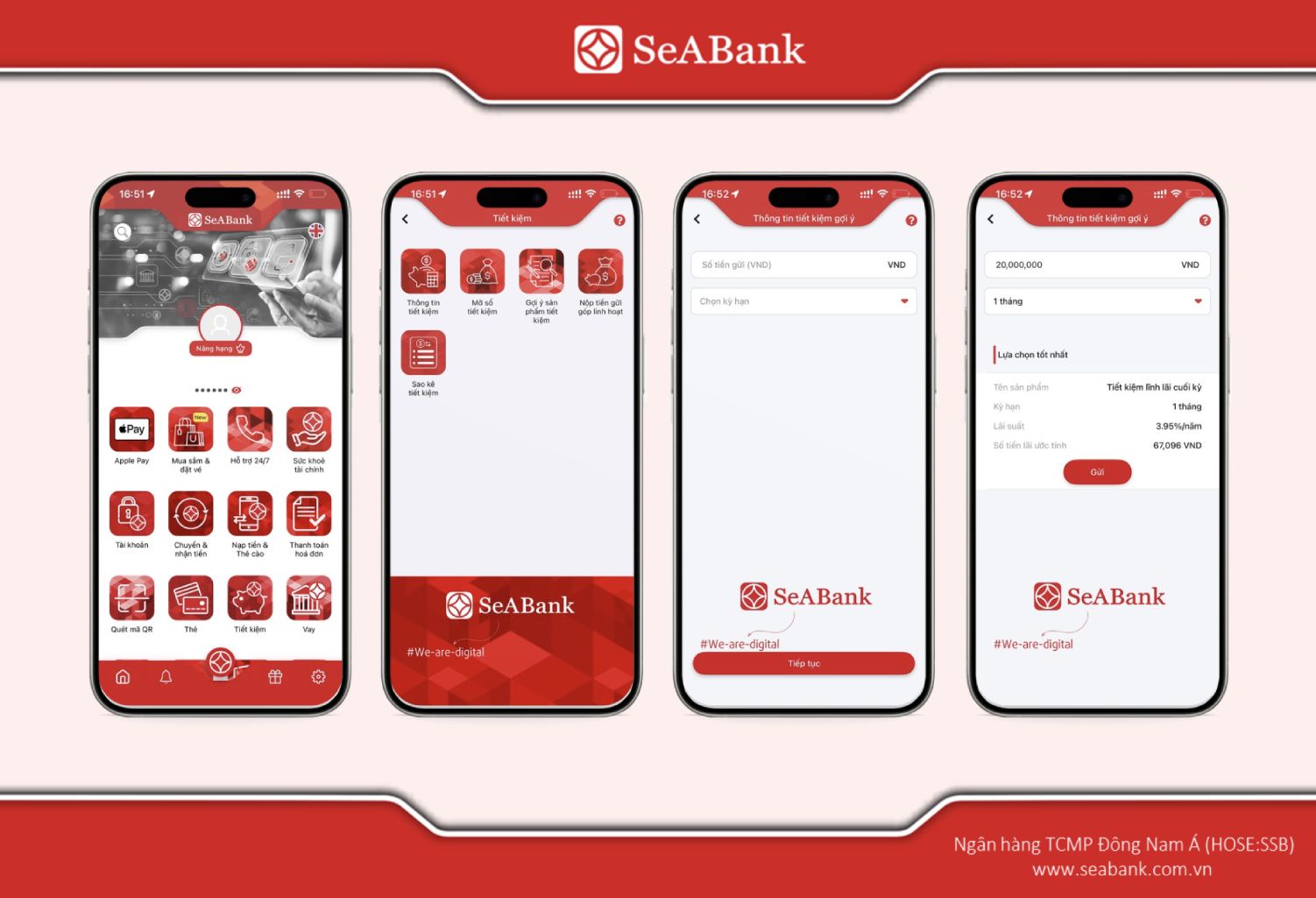
4.2. Steps to Open an Online Savings Account on SeAMobile
You can open an online savings account on SeAMobile in the following 4 steps:
Steps to open an online savings account on the SeAMobile app.
Log in to the SeAMobile app
Download SeAMobile from the App Store or Google Play if you have not installed it yet.
Log in using your registered account.
Select the "Savings" function
Carefully read and confirm your agreement with the product terms and conditions.
Enter the deposit information
Select the funding account and enter the amount you want to deposit.
Select the term and type of savings product that suits your needs.
Check the interest rate and maturity date displayed by the system and select the maturity instruction (if applicable).
Review and confirm the transaction
Review all information before confirming.
Authenticate the transaction according to the instructions in the app (for example, biometrics or OTP).
Once the transaction is successful, the funds will be recorded in your savings account.
Note: The names and locations of menu items in the online savings process above may change depending on the version of SeAMobile.
You do not have the app yet? Download SeAMobile and open an online savings account in just a few minutes.
Useful tip: Not sure which product to choose? Let SeAMobile suggest one for you!
Confused by the wide range of savings products? Tap "Savings Product Suggestions" in the Savings section.
With just a few steps, SeAMobile will analyze your needs and financial situation to recommend the most suitable return-generating solution (Tiered Savings, Monthly Interest Savings, Accumulation Savings, etc.).
Explore and optimize your cash flow today!
Customers can use the savings product suggestion feature to find a more suitable option
5. Important Notes When Saving Money
To make your savings plan effective over the long term, you should keep the following points in mind:
Balance savings with quality of life: Excessive spending cuts can create pressure and make your plan difficult to maintain. You should still allocate a reasonable amount for health, education, and rest.
Choose a term that matches your cash flow needs: If you withdraw money before maturity, the withdrawn amount is usually subject to a lower interest rate (typically the demand deposit interest rate) according to each bank's regulations.
Be cautious of scams: Never share your password or OTP with anyone; be cautious of investment offers promising unusually high returns.
Review your plan periodically: When your income, expenses, or goals change, adjust your savings rate and accumulation method accordingly.
6. Frequently Asked Questions About How to Save Money
1. What Percentage of Income Should You Save Each Month?
There is no fixed percentage suitable for everyone. Under the 50/30/20 rule, you can refer to approximately 20% of income for savings and debt repayment. If your income is still limited, start with 5 - 10% and gradually increase the rate as your financial situation becomes more stable.
2. Can You Save Money with a Low Income?
Yes. What matters is consistency rather than whether the amount is large or small. You can start by recording expenses, reducing unnecessary spending, and choosing recurring savings products that allow small contributions each time.
3. Should You Keep Savings at Home or Deposit Them at a Bank?
Keeping large amounts of cash at home carries a risk of loss and makes it easier to spend the money. Saving at a bank allows your funds to be managed more securely, earn interest, and receive protection under deposit insurance regulations.
4. Is Online Savings Safe?
Online savings deposits are managed by banks through their systems, and transactions are authenticated through multiple layers of security. To use online savings safely, you should download apps only from official app stores, protect your login information, and never share OTP codes with anyone.
Saving is a journey that requires persistence and discipline rather than a large amount of money from the beginning. By setting clear goals, tracking expenses, allocating income appropriately, and choosing a suitable savings method, you can gradually build a solid financial foundation. Start applying the salary-saving methods above today with SeABank.
Southeast Asia Commercial Joint Stock Bank (SeABank)