How to Calculate Household Electricity Bills with Examples Based on the Latest Tiered Tariff
23/10/2026
Guide to calculating household electricity bills under the current tiered tariff, including the formula, latest price table, and easy-to-follow examples.
When receiving the monthly electricity bill, many households are surprised because the amount payable is higher than expected, especially during hot weather. Understanding how to calculate household electricity bills for one month under the tiered tariff helps you proactively monitor consumption and estimate monthly expenses. This article summarizes the calculation formula, latest price table, and illustrative examples so you can apply them immediately.
Note: The figures and information in this article are compiled from general market sources and do not apply exclusively to SeABank's products.
1. What Is the Tiered Household Electricity Tariff?
The tiered household electricity tariff is a progressive method of calculating electricity charges: Monthly electricity consumption is divided into several levels (tiers), with each tier applying a different unit price and each subsequent tier always having a higher price than the previous one. In other words, the more electricity you use, the higher the unit price for the kWh exceeding each threshold; the entire amount of electricity consumed is not charged at the highest rate.
This mechanism is applied in many countries to encourage more economical and reasonable electricity use, while also supporting households with lower consumption levels.
2. Current Tiered Household Electricity Tariff
Under Decision No. 1279/QD-BCT of the Ministry of Industry and Trade, effective from May 10, 2025, the average retail electricity price is 2,204 VND/kWh(*) (excluding VAT), and the household retail electricity tariff is divided into 6 tiers as follows:
Tier
Consumption Level
Price (VND/kWh)(*)
1
0-50 kWh
1,984
2
51-100 kWh
2,050
3
101-200 kWh
2,380
4
201-300 kWh
2,998
5
301-400 kWh
3,350
6
From 401 kWh upward
3,460
For household electricity supplied through prepaid card meters, a fixed rate applies without tiering: 2,909 VND/kWh(*).
(*) Note: Electricity prices were updated as of October 20, 2026, under Decision No. 1279/QD-BCT of the Ministry of Industry and Trade. Prices may be adjusted from time to time under decisions of the Ministry of Industry and Trade and Vietnam Electricity (EVN). You should check the information on your electricity bill or contact your local electricity provider for the latest and most accurate figures.
3. How to Calculate Household Electricity Bills Based on the Tiered Tariff
3.1. Electricity Bill Calculation Formula
Household electricity charges (excluding VAT) are determined using the following formula:
After adding the electricity charges for all tiers, you add value-added tax (VAT) at the current applicable rate to determine the final amount payable on the bill.
3.2. Steps to Calculate Electricity Bills for Rental Rooms and Households
Record the meter reading at the beginning and end of the billing period to determine the total electricity consumption for the month (kWh).
Compare the current tiered electricity tariff to determine the applicable unit price for each tier.
Multiply the number of kWh consumed in each tier by the corresponding unit price, then add the amounts for all tiers.
Add VAT at the current applicable rate to determine the final electricity amount payable.
4. Illustrative Examples of Household Electricity Bill Calculations
Total electricity bill payable: 1,247,500 + 99,800 = 1,347,300 VND
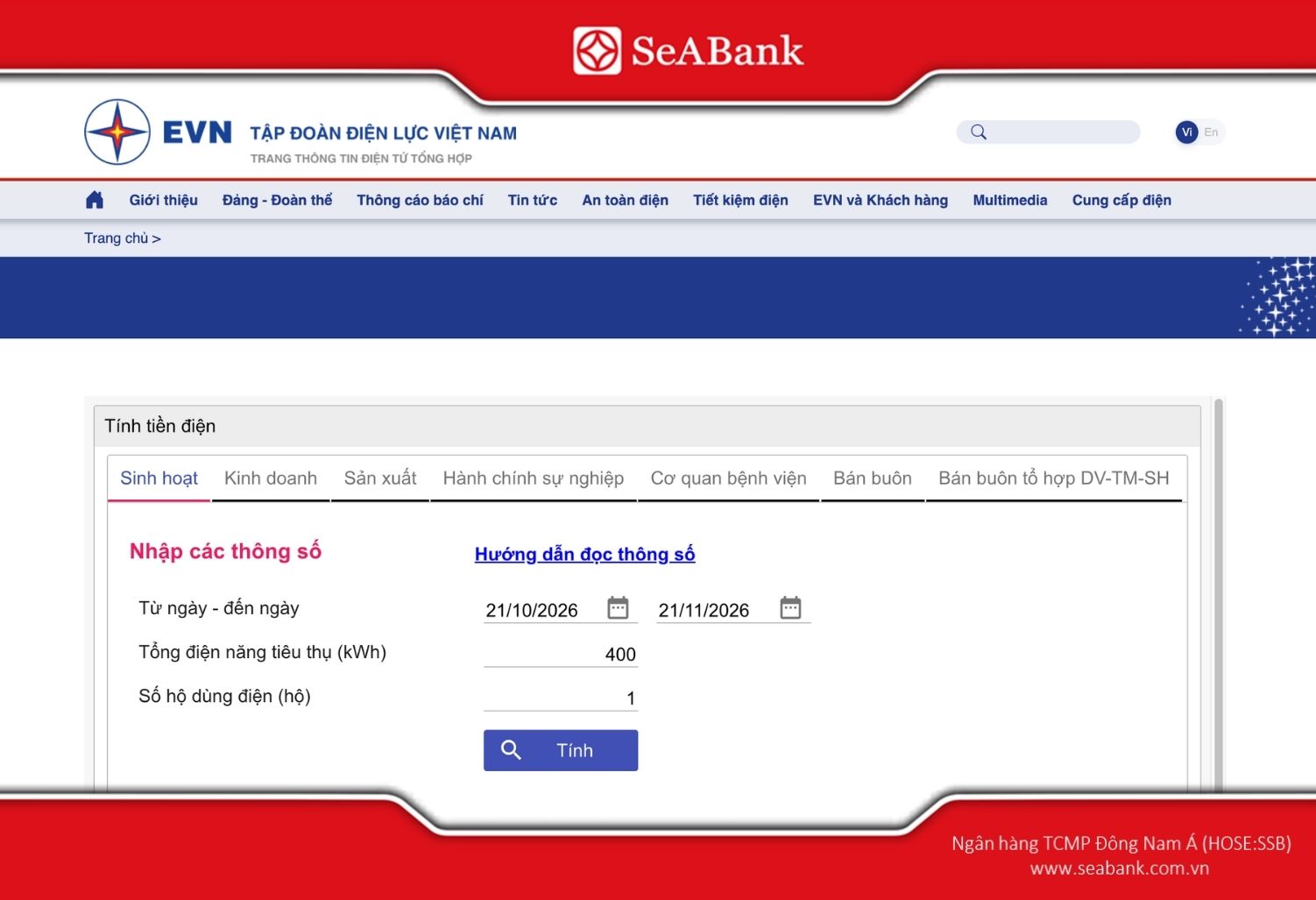
If you do not want to calculate manually, you can use Vietnam Electricity's (EVN) online electricity bill calculator:https://www.evn.com.vn/vi-VN/cong-cu-tinh-hoa-don/. This tool allows you to directly enter the number of kWh used and automatically calculates the corresponding electricity bill, including VAT.
Vietnam Electricity's (EVN) online electricity bill calculator
5. Important Notes When Calculating Household Electricity Bills
Electricity prices may be adjusted periodically: Under Articles 3 and 8 of Decree 72/2025/ND-CP, the average retail electricity price may be reviewed for adjustment every 3 months when input costs fluctuate by 2% or more, equivalent to a maximum of 4 adjustments per year.
Where multiple households share one electricity meter: Under Article 12 of Circular 60/2025/TT-BCT of the Ministry of Industry and Trade, for rental housing, collective housing, and dormitories, every 4 tenants are counted as 1 household for the purpose of applying the tiered consumption allowance. If the number of electricity users cannot be fully declared, all electricity consumption will be charged at the Tier 2 rate.
Where the meter reading period does not coincide with the electricity price adjustment date: The electricity seller will calculate the bill based on the actual number of days to which the old and new prices apply within the same billing period.
A few habits that can help save electricity each month: Turn off devices when not in use, prioritize appliances with energy-saving labels, clean air conditioners regularly, limit the simultaneous use of multiple high-power appliances during peak hours, and monitor electricity consumption regularly to make timely adjustments.
Regularly monitoring electricity consumption helps you proactively control costs
6. Frequently Asked Questions
1. How Much Does 1 kWh of Electricity Cost?
The price of 1 kWh of household electricity is not fixed but depends on the consumption tier for the month, ranging from 1,984 VND/kWh in Tier 1 to 3,460 VND/kWh in Tier 6 under the current tariff, excluding VAT(*).
(*) Note: Electricity prices were updated as of October 20, 2026, under Decision No. 1279/QD-BCT of the Ministry of Industry and Trade. Prices may be adjusted from time to time under decisions of the Ministry of Industry and Trade and Vietnam Electricity (EVN). You should check the information on your electricity bill or contact your local electricity provider for the latest and most accurate figures.
2. How Is Electricity Calculated for Rental Rooms and Rental Housing?
Under Article 12 of Circular 60/2025/TT-BCT, the household electricity allowance for rental housing is calculated based on the actual number of residents, with every 4 people counted as 1 household for electricity consumption purposes. The landlord is responsible for declaring the number of tenants so that the correct tiered allowance can be applied.
3. Why Does the Price per kWh Increase as Electricity Consumption Rises?
This is the principle of the tiered electricity tariff, which is intended to encourage electricity conservation and support households with lower consumption levels. Only the portion of electricity consumption that moves into a higher tier is charged at the higher unit price, not the entire amount of electricity used.
4. How Often Can Household Electricity Prices Be Adjusted?
Under the current mechanism, the average retail electricity price may be reviewed for adjustment up to 4 times per year whenever input costs fluctuate sufficiently to meet the regulatory conditions.
5. Can You Monitor and Calculate Your Monthly Electricity Bill Yourself?
You can estimate it yourself by recording the meter readings and applying the formula and tariff table above. In addition, many digital banking apps now also support electricity bill viewing and payment, making it more convenient to monitor your consumption history.
Understanding how to correctly calculate monthly electricity bills for households and rental rooms under the tiered tariff helps you control spending and avoid unexpected increases in bills during peak seasons. Record your meter readings each month, compare them with the current tariff, and apply suitable electricity-saving tips to optimize your household budget. Paying bills on time also helps you manage your finances more effectively.
Convenient electricity bill payments with SeAMobile: Instead of having to remember payment schedules and visit collection points, you can pay electricity, water, internet, and other utility bills directly through SeABank's SeAMobile digital banking app in just a few steps. The app automatically saves information for future payments and sends bill reminders through notifications. Learn more about Digital Banking features at SeABank.
Southeast Asia Commercial Joint Stock Bank (SeABank)