News
Should You Open a Bank Savings Account? Comparison with Other Investment Channels
 16/10/2026
Should you save money in a bank? Discover the pros and cons, comparisons with other investment options, and tips to maximize your interest returns.
When you have idle cash, you might wonder: Should you put your money in a bank savings account or explore other investment channels? Each option offers its own balance of returns and risks tailored to specific financial goals. This article will help you understand the key benefits, important considerations, how to compare bank savings with other investment vehicles, and practical tips to maximize your deposit returns.
1. Why Bank Savings Deposits Remain a Staple
Bank savings accounts continue to be a go-to vehicle for wealth preservation thanks to their uncompromised security and unmatched convenience.
1.1. Superior Safety and Low Risk Exposure
Unlike volatile assets such as equities, crypto, or real estate, bank deposits stand out as one of the safest vaults for your capital:
- Tight Regulatory Oversight: The banking sector operates under the rigorous purview of the State Bank of Vietnam and the Law on Credit Institutions. System-wide risk controls, mandatory reserve standards, and proactive intervention protocols safeguard operational stability.
- Deposit Insurance Coverage: Personal deposits at licensed credit institutions are legally protected under national deposit insurance frameworks, ensuring your money remains secure even in adverse economic environments.
1.2. Guaranteed, Predictable Cash Flow
Opening a term deposit locks in a mutually agreed interest rate for a predetermined duration. This clarity allows depositors to forecast exact earnings - whether paid out periodically (monthly/quarterly) or compounded at maturity - completely immune to wild market swings.

1.3. Flexible Liquidity Management
Bank deposits adapt readily to diverse time frames and emergency capital demands:
- Comprehensive Tenor Options: Terms span from ultra-short windows (1 week, 1 to 5 months) to medium and long horizons (6 to 36 months).
- Early Withdrawal Feasibility: If unforeseen expenses surface, depositors can redeem their principal ahead of schedule. The early withdrawal portion simply defaults to the bank's non-term demand rate, giving you peace of mind and operational agility.
1.4. Seamless Digital Portfolio Control
With modern digital banking, managing funds is effortless. You can initiate deposits, monitor balances, configure auto-renewals, or close accounts around the clock on your mobile device - saving you trips to the counter.
2. Key Considerations Before Committing Funds
Despite stellar marks for capital preservation, traditional savings accounts do feature a few trade-offs worth factoring into your overall strategy.
2.1. Inflation’s Drag on Purchasing Power
Inflation quietly chips away at cash returns. Your net real return equals the nominal rate minus the inflation rate:
- For instance, if your bank yields 6% annually while inflation runs between 3.5% and 4%, your real wealth grows by merely 2% to 2.5%.
- In high-inflation regimes, fixed interest earnings may fail to outpace rising costs of living, subtly degrading the actual purchasing power of your money over time.
2.2. Modest Long-Term Wealth Expansion
Looking through a multi-year lens:
- Savings deposits are not designed for exponential capital multiplication compared to growth-oriented sectors like stocks or real estate during broader economic expansions.
- A savings account acts fundamentally as a defensive cushion and a predictable cash generator rather than a tool for aggressive wealth compounding.
2.3. Penalties on Early Redemption
Opting for extended tenors (such as 12 or 24 months) captures peak interest rates. However, liquidating your entire balance prior to the maturity date triggers a steep reduction, resetting your yield to the minimal non-term rate (typically a fraction of a percent, around 0.1% - 0.5% per year). This wipes out the bulk of the interest you built up.

3. Bank Savings vs. Alternative Investment Vehicles
No investment vehicle is a one-size-fits-all solution. Each channel balances yield, volatility, and liquidity differently:
Experienced wealth managers rarely bet on a single horse. Instead, they parcel out capital across multiple buckets—anchoring essentials and rainy-day funds in liquid savings, while allocating discretionary balances to higher-upside channels matching their risk appetite. (Note: This overview serves as general reference and does not constitute formal financial advice).
4. The Verdict: Should You Put Your Money in a Bank Savings Account?
Determining whether to place funds in a savings account hinges on your specific timeline, cash requirements, and emotional comfort with market swings.
4.1. You SHOULD Opt for a Savings Account If:
- Establishing an Emergency Reserve: You need a dependable financial safety net covering 3 to 6 months of baseline living costs. Bank deposits remain the undisputed gold standard here.
- You Are Strictly Risk-Averse: You prioritize capital safety above all and prefer not to lose sleep over everyday market swings.
- Funding Short-Term Financial Goals: You are earmarking funds for commitments due in the next 1 to 3 years, like purchasing a car, funding a wedding, or paying tuition.
- Preserving Retirement Funds: You are in or entering retirement and rely on secure, fixed payouts to comfortably handle recurring lifestyle expenses.
4.2. You SHOULD CONSIDER Other Channels If:
- You have a strong stomach for market volatility and your overarching objective is multiplying net worth over 10 to 20 years.
- You possess the necessary domain knowledge, analytical skill, and dedicated time to actively navigate equities, real estate, or business ventures.
5. Pro Tips to Optimize Your Bank Savings Yield
To unlock maximum value from your cash deposits, apply these practical strategies:
- Align Maturities with Life Events: Pinpoint when you will actually need liquidity so you can pick terms that mature close to that target date, avoiding costly early withdrawals.
- Compare Rates and Disbursement Frequencies: Beyond base rates, assess how interest is distributed (end-of-term, monthly, or upfront) to match your personal cash flow pattern.
- Capitalize on Digital Banking Channels: Financial institutions routinely grant interest rate premiums to customers opening accounts online versus over-the-counter.
- Deploy a CD Laddering Structure: Split your principal across multiple separate accounts with staggered maturity dates. If an unexpected bill lands, you only liquidate one smaller slice while the remaining balances continue compounding undisturbed.
- Build Wealth with Systematic Contributions: If you have regular surplus income, set up recurring deposits to build sustainable financial momentum over time.
- Stay Sharp on Account Terms: Pay attention to rollover settings, post-maturity interest terms, and prevailing benchmark moves so you can actively adjust your allocations.

6. Grow Your Wealth with SeABank on SeAMobile
Whether you prefer visiting a local branch or managing your money end-to-end via digital banking, SeABank provides an extensive suite of tailored savings options:
- End-of-Term Interest Savings: Geared toward maximizing total compound yield upon final maturity.
- Monthly Payout Savings: Designed for savers seeking a steady, supplemental income stream each month.
- Upfront Interest Savings: Collect your interest upfront right when the account is opened.
- Future Growth Installment Savings: Flexible recurring deposits starting from as little as VND 200,000 per contribution.
- Smart Savings: A non-term liquidity product that lets you park cash while keeping immediate spending access intact.
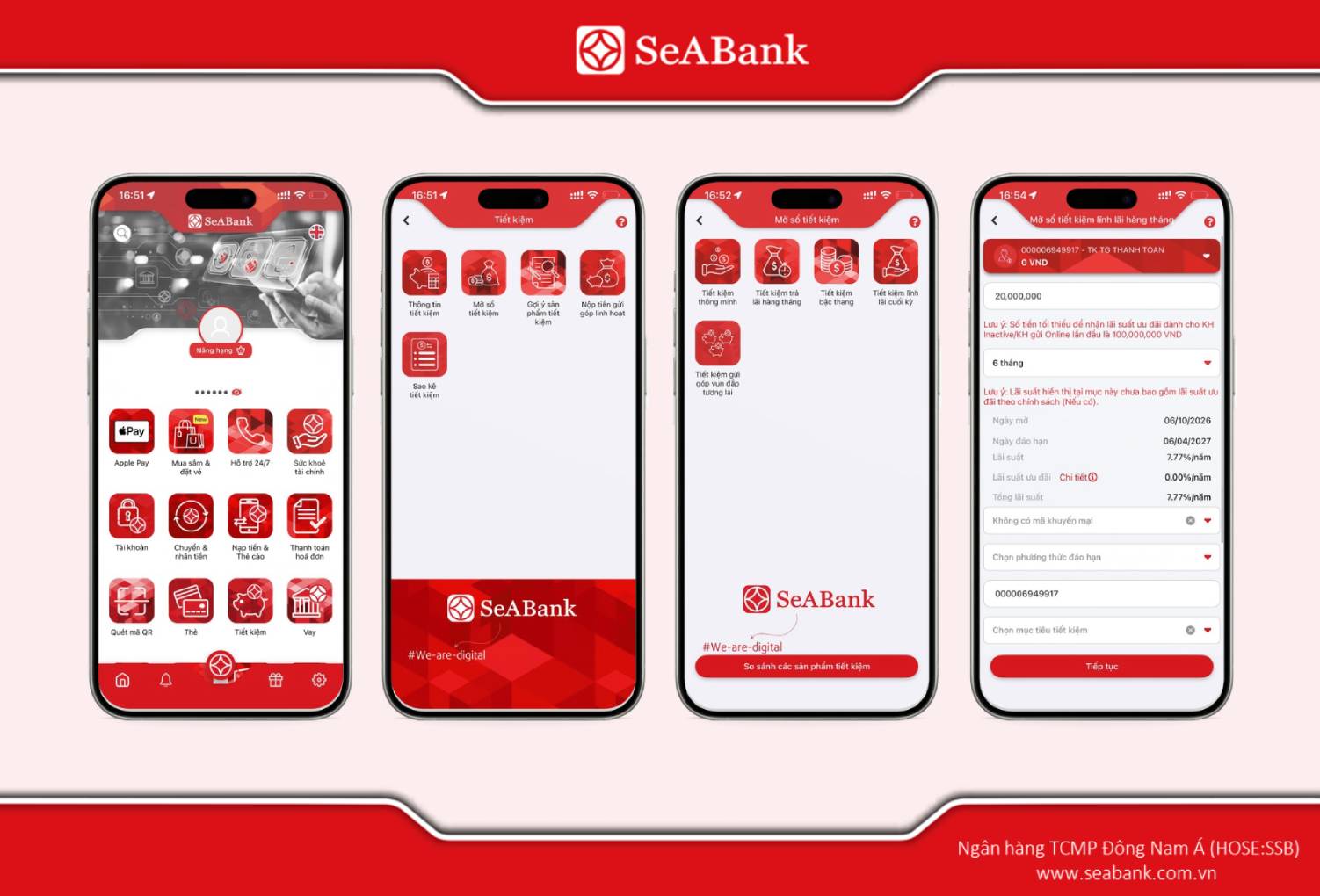
Quick steps to open a digital savings account on SeAMobile:
- Download and log into the SeAMobile application.
- Select the Savings / Open Online Savings feature.
- Choose your preferred package, maturity tenor, amount, and interest disbursement method.
- Review your terms and authenticate the transaction.
Review SeABank's complete lineup of savings options and up-to-date interest rate tables on our official website, or download SeAMobile from the App Store or Google Play to start earning today.
7. Frequently Asked Questions (FAQ)
1. Should you put your money in a bank savings account during high inflation?
It comes down to asset purpose. Savings deposits remain indispensable for liquidity reserves and liabilities with definite due dates. Benchmark the nominal interest rate against current inflation numbers; if you can tolerate some market risk, you can route non-essential capital into growth assets.
2. Are bank deposits protected by deposit insurance in Vietnam?
Yes. Under Article 17 of the Law on Deposit Insurance 2025, individual VND deposits placed at participating credit institutions - including term savings- are legally protected by statutory deposit insurance.
3. Is interest from bank savings subject to personal income tax (PIT)?
No. In accordance with Clause 6, Article 4 of the Personal Income Tax Law 2025 (effective July 1, 2026), interest income generated from bank deposits at credit institutions remains entirely exempt from personal income tax.
4. Will I lose my accrued interest if I withdraw before maturity?
The funds withdrawn ahead of term will revert to the institution’s lowest demand (non-term) interest rate. If you only make a partial redemption, the untouched remainder continues to compound at your original contracted rate. Review your contract fine print before liquidating.
5. Should I choose a short tenor or a long tenor?
Longer terms typically unlock higher interest rates but tie up your capital. Choose a tenor that aligns with when you expect to spend the funds, or diversify your principal across multiple maturities to achieve the best mix of yield and liquidity.
Ultimately, whether you should put your money in a bank savings account depends on your personal financial roadmap, liquidity requirements, and risk appetite. Fixed savings remain the bedrock of capital preservation and steady cash flow, while growth assets can take on your long-horizon goals. Download the SeAMobile app today to check out our latest savings packages, compare competitive interest rates, and start growing your funds with complete peace of mind.
Related News
What Is a Savings Account? Types and a Quick Guide to Opening One 13/11/2026
What Is Online Savings? How to Save and 6 Important Notes 13/11/2026
How to Make an Online Savings Deposit Easily and Earn Attractive Returns 05/11/2026
What Is Flexible Savings? Comparison with Traditional Savings 05/11/2026
Online Land Tax Payment: 2 Quick and Compliant Methods 05/11/2026

What Is a Savings Account? Types and a Quick Guide to Opening One
What is a savings account and how is it different from a payment account? Learn about common types of savings deposits, their benefits, and how to open an account online or at a branch.
13/11/2026
Read more


What Is Online Savings? How to Save and 6 Important Notes
What is online savings? Learn about its advantages, how to open a savings account on a banking app, and important notes on interest rates, security, and deposit insurance for online savings in this article.
13/11/2026
Read more

How to Make an Online Savings Deposit Easily and Earn Attractive Returns
Learn how to make an online savings deposit on SeAMobile in 4 steps, including requirements, interest rates, early withdrawal, and deposit insurance.
05/11/2026
Read more