News
How Do Household Businesses Pay Taxes Starting in 2026? Tax Calculation, Declaration, and Payment Guide
 02/10/2026
How do household businesses pay taxes under the latest 2026 regulations? A detailed guide to applicable taxes, calculation formulas, industry-specific tax rates, and tax declaration and payment procedures.
How household businesses pay taxes is a common concern among business owners. This article provides a detailed overview of the taxes they are required to pay, calculation formulas based on annual revenue brackets, and the procedures for electronic tax declaration and payment, helping business owners understand and fulfill their tax obligations.
1. What Taxes Do Household Businesses Pay? 5 Types of Taxes They May Be Required to Pay
Under Clause 7, Article 10 of Resolution No. 198/2025/QH15, as of January 1, 2026, the presumptive tax regime and business license fees for household businesses and individual business owners have officially been abolished. Household businesses are now primarily subject to two types of taxes: value-added tax (VAT) and personal income tax (PIT), in addition to certain industry-specific taxes and fees, including:
- Special consumption tax for household businesses engaged in the production of alcohol, beer, tobacco, and gasoline, or providing services such as nightclubs and karaoke venues, among others.
- Natural resource tax for household businesses involved in the extraction of natural resources, such as minerals, crude oil, natural gas, forest products, natural seafood, and natural water.
- Environmental protection fees for mineral extraction.
1.1. Value-Added Tax (VAT)
VAT is an indirect tax(*) levied on the additional value of goods and services generated throughout the production, distribution, and consumption process. For household businesses, VAT is calculated using the direct method based on revenue. This means that the taxable revenue is multiplied by the applicable VAT rate for each business sector. The applicable rates and taxable revenue are determined in accordance with the Law on Value-Added Tax No. 48/2024/QH15 and its implementing regulations.
(*) An indirect tax is ultimately borne by the end consumer, while the business or household business is responsible for declaring and paying the tax to the State on the consumer’s behalf.*
Under Article 3 of Decree No. 68/2026/ND-CP, as amended by Decree No. 141/2026/ND-CP dated April 29, 2026, household businesses and individual business owners with annual revenue of 1 billion VND or less are exempt from VAT. This is an important change: the initial revenue threshold for VAT exemption was 500 VND million per year, but Decree No. 141/2026/ND-CP raised it to 1 billion VND per year, with uniform application from January 1, 2026.
1.2. Personal Income Tax (PIT)
PIT is a direct tax(**) imposed on the income earned by household business owners from production and business activities.
As with VAT, the annual revenue threshold for PIT exemption has been raised from VND 500 million to 1 billion VND under Decree No. 141/2026/ND-CP. Household businesses with annual revenue of 1 billion VND or less are not required to pay PIT on business income, but they must still report their actual revenue to the tax authorities within the prescribed deadline.
(**) A direct tax is levied directly on the income or assets of individuals and organizations. The taxpayer is also the person who bears the tax.
2. Detailed Guide to Calculating Taxes for Household Businesses by Revenue Bracket
Once a household business has determined that it is subject to tax, it needs to understand how to calculate the amount payable. VAT is calculated using the direct method based on revenue, while PIT is calculated using one of two methods, depending on annual revenue.
2.1. VAT and PIT Calculation Formulas
The VAT and PIT rates applicable to each business sector are determined with reference to the Law on Value-Added Tax No. 48/2024/QH15, the Law on Personal Income Tax No. 109/2025/QH15, and their implementing regulations. The applicable rates are summarized below:
VAT and PIT Rates by Business Sector (for taxpayers using the revenue-based method, with annual revenue of over 1 billion VND to 3 billionVND)
PIT Rates (for taxpayers using the taxable-income-based method)
Note: The applicable rates may be adjusted under the latest implementing regulations. Household businesses should check the current circulars or consult their directly managing tax authority before filing their tax returns.
2.2. Revenue Brackets and Corresponding Tax Calculation Methods
Based on annual revenue, household businesses are classified into different groups, each with its own tax obligations and calculation methods.
3. Procedures for Declaring and Paying Taxes to the Tax Authorities
The transition to a tax declaration system requires household businesses to take a more proactive approach to fulfilling their tax obligations. The following is a detailed overview of the process.
Step 1: Register for an Electronic Tax Account
- Prepare your personal identification number/tax identification number, registered phone number, and email address for verification purposes.
- Access the eTax Mobile app (available on the App Store or Google Play) or the tax authority’s electronic portal for individuals, then select "Register."
- Enter your personal information and verify your registration using the OTP sent to your registered phone number.
- If you already have a Level 2 VNeID electronic identification account, you can sign in using VNeID to shorten the verification process.
- Once registration is complete, the system will send a notification via SMS or email containing your login information.

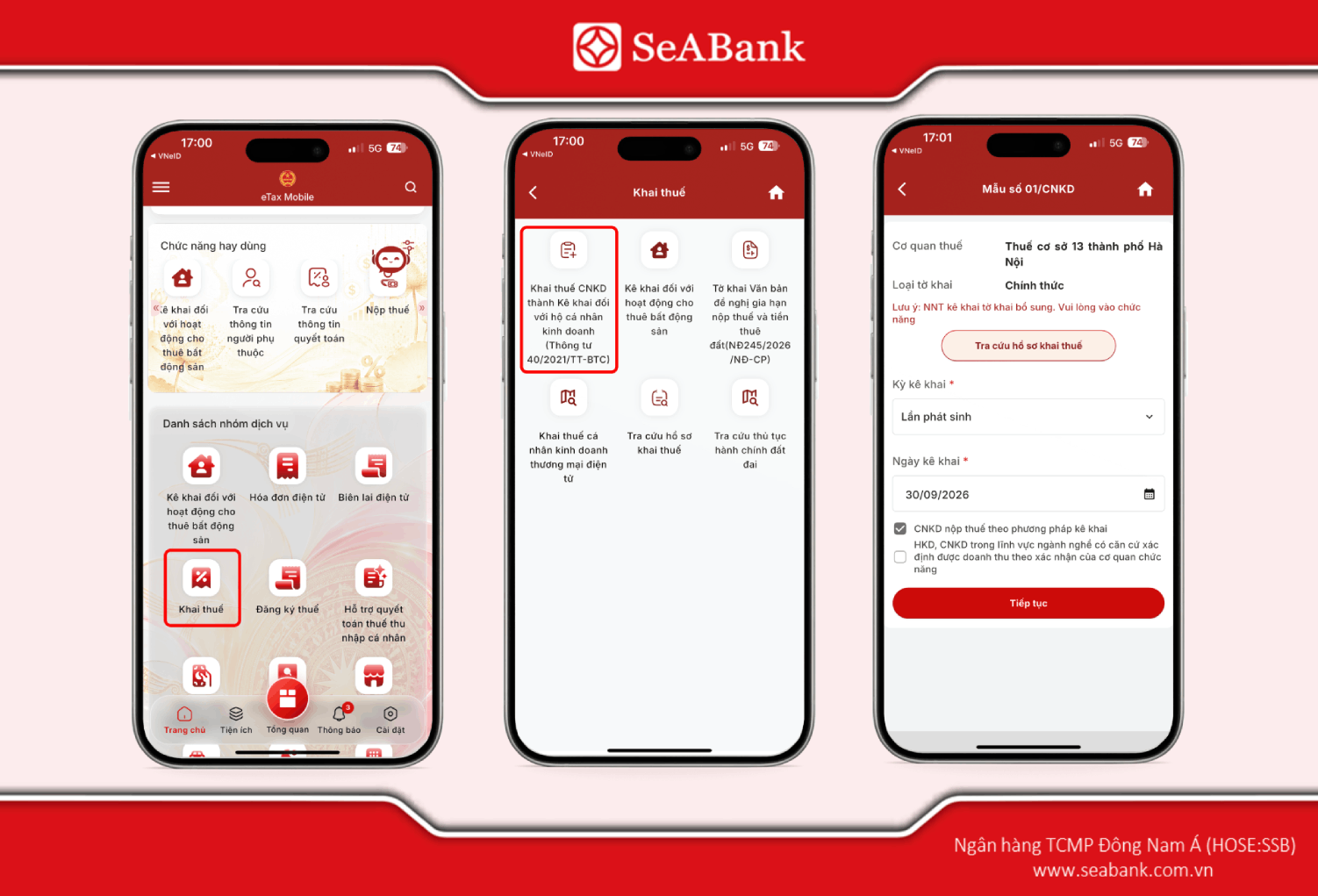
Step 2: File Your Tax Return
- Log in to the electronic tax system and select the appropriate tax return form (typically Form 01/CNKD for individuals and household businesses filing under the declaration method).
- Determine your filing frequency: quarterly for businesses with annual revenue of over VND 1 billion to VND 50 billion, monthly for those with revenue exceeding VND 50 billion, or annually for declaration/finalization in certain cases.
- Enter all required information, including revenue, tax type, and tax period, and complete the business activity schedule for transactions arising during the period, if applicable.
- Review the figures and submit the tax return using a digital signature or OTP.
- Save the submitted tax return in PDF or XML format for future reference, reconciliation, and tax finalization.
Step 3: Pay Taxes Through Electronic Channels
- Select a tax payment method: through the eTax Mobile app, the tax authority’s public service portal, or a banking app that supports electronic tax payments.
- Enter your tax identification number, select the tax period, and choose the type of tax to be paid.
- Verify the amount due, then select a bank account or scan a QR code to make the payment.
- Authenticate the transaction using an OTP or digital signature to complete the payment.
- Save the electronic tax payment receipt for future reference and reconciliation, if needed.
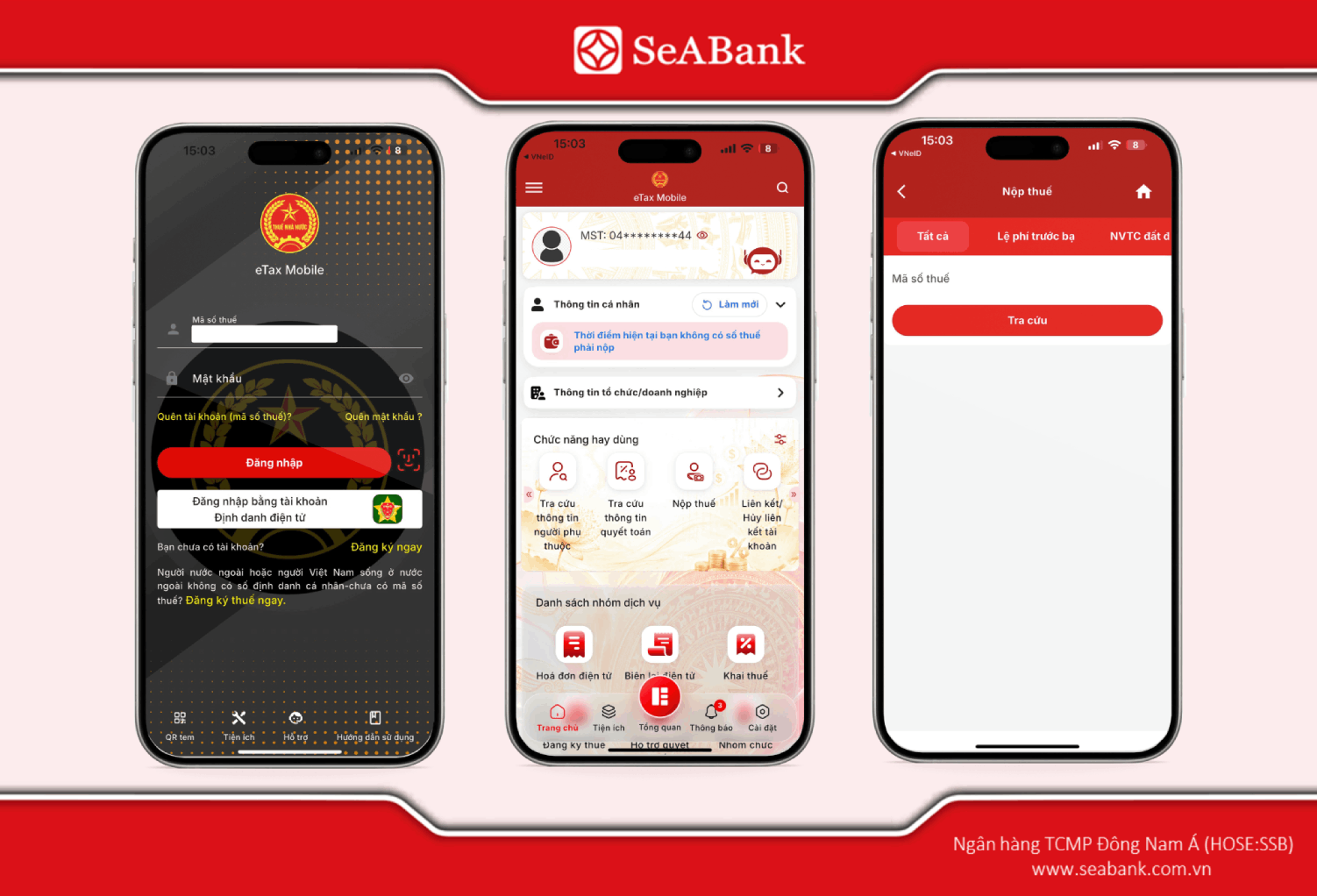
Household businesses can check their tax payment status, outstanding tax liabilities, and notifications from the tax authorities directly through eTax Mobile or the electronic tax portal. This allows business owners to monitor their tax obligations proactively and avoid outstanding tax liabilities.
4. Frequently Asked Questions (FAQs)
1. Do household businesses still have to pay presumptive tax?
No. As of January 1, 2026, the presumptive tax regime and business license fees have officially been abolished under Resolution No. 198/2025/QH15. Household businesses have transitioned to a system in which they declare, calculate, and pay their own taxes based on actual revenue or income generated.
2. What is the current annual revenue threshold for household businesses to be exempt from tax?
Under Decree No. 141/2026/ND-CP, which amends Decree No. 68/2026/ND-CP, the revenue threshold for VAT and PIT exemption has been raised from VND 500 million to VND 1 billion per year, effective January 1, 2026. Household businesses with annual revenue of VND 1 billion or less are not required to pay these two taxes but must still notify the tax authorities of their revenue.
3. How are VAT and PIT calculated for household businesses?
Both taxes are generally calculated using the direct method based on revenue, by multiplying taxable revenue by the applicable rate for each business sector. However, household businesses with annual revenue exceeding VND 3 billion are required to calculate PIT based on taxable income (revenue minus deductible expenses) multiplied by the applicable tax rate.
4. Should household businesses file tax returns monthly or quarterly?
The filing frequency depends on annual revenue. Household businesses with revenue of over VND 1 billion to VND 50 billion generally file quarterly, while those with annual revenue exceeding VND 50 billion are required to file monthly under current regulations.
5. How can household businesses manage cash flow for tax payments more effectively?
Household businesses should consider using a dedicated payment account for business activities, with clear account statements, support for electronic tax payments, and free transfers. This can make revenue reconciliation easier and help ensure that sufficient funds are available for each tax payment period.

In summary, how household businesses pay taxes depends on their annual revenue and specific business activities. Starting in 2026, the tax-exempt revenue threshold has been raised to VND 1 billion per year. Understanding the calculation formulas and declaration and payment procedures, while using technology to manage cash flow, can help household businesses fulfill their tax obligations and operate more transparently and efficiently.
Note: This article is for reference purposes and is based on Resolution No. 198/2025/QH15, Decree No. 68/2026/ND-CP, and Decree No. 141/2026/ND-CP as of the time of writing. As tax policies may continue to change over time, household businesses should check with their directly managing tax authority or the official portals of the Government and the General Department of Taxation for the latest regulations applicable to their specific circumstances.
Related News
How Much Is 1 Tael Of Gold? Update Today's Gold Price And Notes 09/10/2026
Russian Currency: Denominations, Exchange Rates, and How to Exchange Russian Rubles 09/10/2026
What Is German Currency? Denominations, Exchange Rates, and How to Convert to Vietnamese Dong 09/10/2026
What Is a Dynamic QR Code? Comparison with Static QR Codes and How to Create One 09/10/2026
How to Create a Bank QR Code on SeAMobile in Just 3 Steps 09/10/2026

How Much Is 1 Tael Of Gold? Update Today's Gold Price And Notes
How much is 1 tael of gold? Update the latest price of 1 tael of 9999, 24K, 18K gold today and instructions on how to calculate and buy gold safely and reliably.
09/10/2026
Read more


Russian Currency: Denominations, Exchange Rates, and How to Exchange Russian Rubles
Learn about Russian currency (Ruble), including its denominations, the current RUB/VND exchange rate, where to exchange money, and tips for exchanging Rubles when traveling to Russia. Find out more with SeABank.
09/10/2026
Read more
What Is German Currency? Denominations, Exchange Rates, and How to Convert to Vietnamese Dong
Germany's currency is the euro (EUR). Learn about German currency denominations, the EUR/VND exchange rate, where to exchange money, and how to receive money from Germany in Vietnam via SeABank.
09/10/2026
Read more