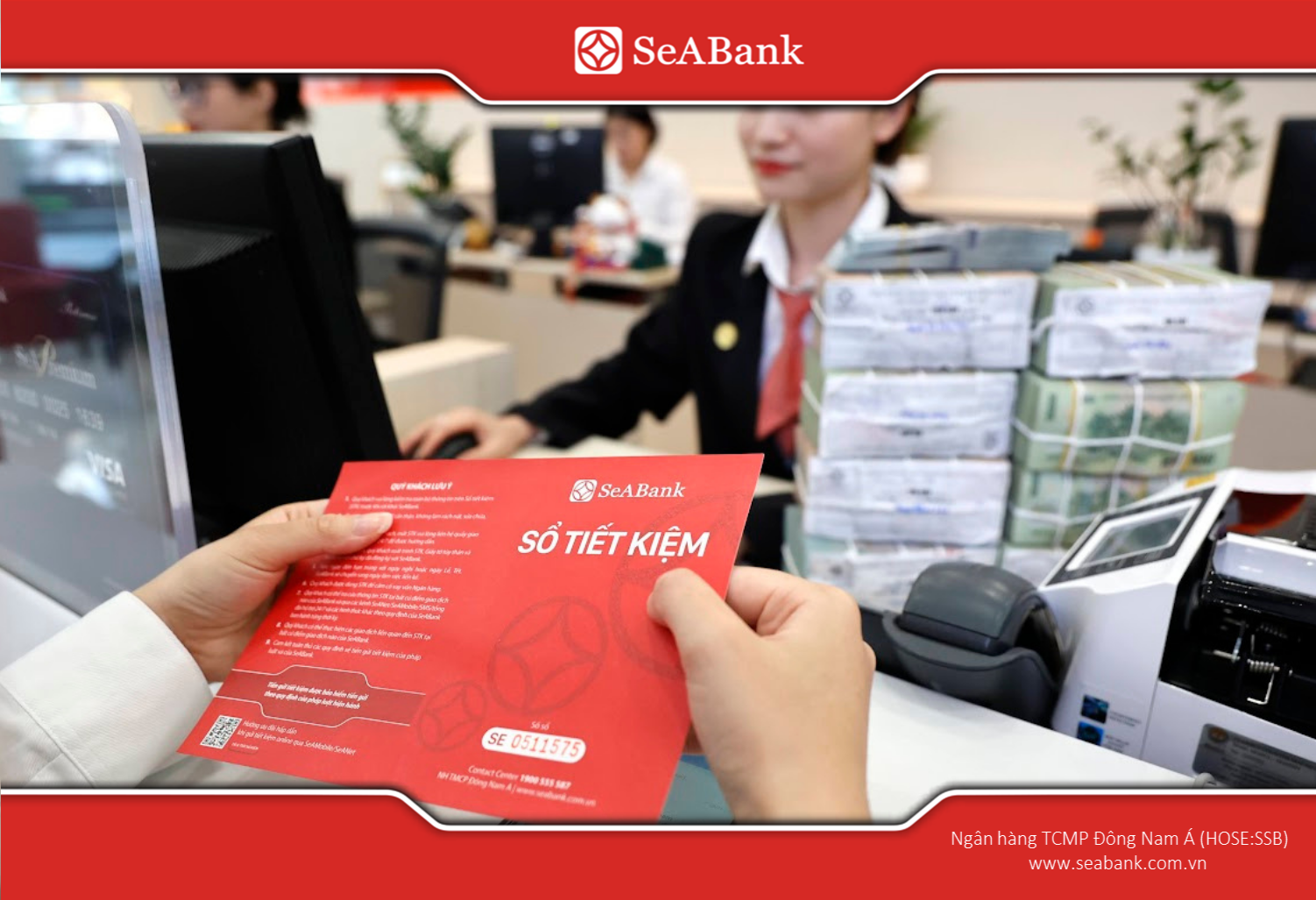
What Is a Savings Passbook? Tips for Opening a High-Yield Savings Account
25/09/2026
What is a savings account? Should you open one? Let’s explore the requirements, terms, and interest rates for opening a new savings account today!
Today, opening a savings account remains a popular and trusted choice for many customers thanks to its benefits as well as its safety and security. However, not everyone knows exactly how to open a savings account in a way that maximizes returns. Today, let's explore with SeABank the key points depositors should keep in mind to earn the highest possible returns when opening a savings account at a bank!
Note: The figures and information in this article are compiled from general market sources and do not apply specifically to SeABank's products.
1. What Is a Savings Passbook?
A savings passbook is a document issued by a bank to a customer upon making a savings deposit, used to confirm ownership of the deposit and to serve as the basis for calculating interest and settlement.
Key information typically found on a savings passbook includes:
Bank information: Bank name, logo, official seal, along with the signatures of the teller and the bank's legal representative.
Account holder information: Full name, signature of the account holder (or their legal representative/authorized person), and personal identification details of the depositor.
Other information: Procedures for cases where the passbook is damaged, worn, lost, or torn; instructions for looking up deposit information, etc.
Note: The format, layout, and some specific details on a savings passbook may vary depending on each bank's individual regulations.
A savings passbook fully records information about the deposit amount, term, and interest rate of the customer
2. Things to Know Before Opening a Savings Account
2.1. Eligibility to Open a Savings Account
Under Article 3 of Circular No. 48/2018/TT-NHNN dated December 31, 2018, issued by the State Bank of Vietnam on savings deposits, savings depositors are defined as follows:
Vietnamese citizens aged 18 or older with full civil capacity as prescribed by law.
Vietnamese citizens aged 15 to under 18, who are not restricted in or deprived of civil capacity.
Vietnamese citizens under 15 years of age, or those restricted in or deprived of civil capacity as prescribed by law, must carry out savings deposit transactions through a guardian or legal representative.
2.2. Savings Deposit Terms
Under Article 6 of Circular 48/2018/TT-NHNN, savings deposit products are classified by deposit term, with specifics determined by each credit institution.
Accordingly, the market currently offers two main types of savings terms:
No fixed term: Deposits and withdrawals can be made flexibly at any time, suitable for contingency needs or when the timing of fund use has not yet been determined.
Fixed term: Deposits are held for a fixed period (weeks, months, or years) as announced by the bank, typically offering a higher reference interest rate than no-term deposits, but requiring customers to carefully consider when they will need to access the funds.
2.3. Savings Interest Rates
Savings interest rates in the current market vary depending on the term, deposit method, and each bank's individual policy at any given time.
Longer deposit terms are generally accompanied by higher reference interest rates; however, flexibility for early withdrawal is correspondingly lower.
2.4. Maturity Date and Passbook Settlement
Maturity is the point at which the registered term ends, at which point the customer may settle or renew the passbook.
Under Article 15 of Circular 48/2018/TT-NHNN, if a customer does not come to withdraw funds by the maturity date and has made no other request or agreement, the credit institution will automatically extend the deposit for a new term in accordance with its regulations for that type of deposit.
Under Article 17 of Circular 48/2018/TT-NHNN, early withdrawal of savings deposits is carried out according to the agreement between the credit institution and the customer at the time of deposit. In practice, early-withdrawn amounts are typically only credited with the no-term interest rate rather than the original fixed-term rate.
Understanding the eligibility conditions, terms, and maturity timing helps customers be more proactive when opening a savings account
3. Benefits of Opening a Savings Account
Opening a savings account at a bank offers customers outstanding benefits, helping to optimize and protect capital effectively:
Optimal, stable returns: Instead of letting your money sit idle, a savings deposit allows your funds to continuously grow through a fixed, predetermined interest rate, providing a safe source of passive income.
Flexible terms: A wide range of term options makes it easy to choose a plan that fits your financial plans and to actively manage your personal cash flow.
Safety and security: Depositing money at a bank eliminates risks such as theft or fire, compared with keeping cash at home.
Low risk: This is currently one of the safest forms of investment, as the entire banking system is closely supervised and managed by the State.
4. Types of Bank Savings Passbooks Today
Banks currently offer two forms of savings passbooks: traditional (paper) passbooks and online savings accounts, giving customers more options when choosing how to open an account.
The comparison table below helps illustrate the differences between the two types:
Criteria
Traditional Passbook (In-Branch)
Online Savings Account
Method of opening
Visit a branch/transaction office directly
Done through the bank's digital app, no branch visit required
Time required
Requires travel and waiting at the counter
Fast, can be done anytime, anywhere with internet access
Documents required
Original personal identification documents
Verification via registered account and OTP
Format
Physical paper passbook
Electronic passbook, managed via app
Best suited for
Customers not yet familiar with online transactions
Customers who prioritize convenience and speed
5. Tips for Opening a Savings Account to Maximize Returns
Choose the right deposit term: One advantage of a savings deposit is that you can deposit any amount within your means and choose a term that suits you. Generally, longer-term deposits carry higher interest rates than shorter ones. However, withdrawing early means the deposit will be credited with the low no-term interest rate, or in some cases no interest at all. Therefore, before deciding on a term, you should carefully consider how readily available you need your funds to be.
Choose the right bank and interest rate: To ensure your savings deposit is both safe and effective, you should consider choosing a reputable bank that also offers a favorable interest rate. Interest rate is a top priority factor, so pay close attention to it to maximize your returns.
Note the maturity and settlement date: Avoid withdrawing your savings deposit before the maturity date, as the bank will apply the no-term interest rate or no interest at all. For this reason, carefully consider the deposit amount and term from the very beginning.
Protect personal information and keep a consistent signature on your passbook: As a long-term form of investment, your personal information with the bank is extremely important. In addition, your signature carries significant legal value with the bank. You should therefore ensure you have a consistent signature so the bank can easily verify it, saving you time when settling the account later.
Before deciding on a deposit term, you should carefully consider how readily available you need your funds to be
6. Procedure for Opening a Savings Account
6.1. Opening a Savings Account at a Branch
To open a savings account directly at a branch, simply follow these steps:
Step 1: Prepare your documents:
Customers aged 18 and older: A valid ID card/citizen ID/passport.
Customers aged 15 to under 18: A valid ID card/citizen ID/passport (must not be restricted in or deprived of civil capacity).
Customers under 15 (or those restricted in or deprived of civil capacity): The identification document/birth certificate of the account holder is required, along with the identification and proof of guardianship/legal representation documents of the guardian or legal representative.
Step 2: Bring your documents and visit the bank's branch or transaction office directly.
Step 3: After receiving the documents, bank staff will verify the information. If everything is in order, the bank will open the savings account for the customer.
Currently, the Southeast Asia Commercial Joint Stock Bank (SeABank) system has a total of 48 branches and 133 transaction offices across many key provinces and cities nationwide, making it easy and convenient to find the nearest transaction point, saving time and travel costs.
Look up the nearest branch at: SeABank Transaction Locations.
6.2. Opening a Savings Account Online
SeABank is one of the most reputable banks in Vietnam offering online savings account services through the SeAMobile/SeANet app. To open a savings account online via SeAMobile/SeANet, follow these steps:
Step 1: Log in to the SeAMobile/SeANet app using your registered password and account.
Step 2: Find the "Online Savings" section, then select "Open Account."
Step 3: Select your payment account and provide full details, including: deposit currency, deposit amount, deposit method, term, and interest payment method.
Step 4: After entering all the information, double-check that everything is correct. If accurate, select "Confirm."
Step 5: The SeABank digital banking system will immediately send an OTP code to your phone via SMS. Enter the code to complete the online savings deposit.
The SeAMobile/SeANet app
Discover the optimal savings solution for your finances today!
Explore attractive interest rate packages and flexible deposit methods with SeABank Savings Products. For detailed consultation, please contact your nearest SeABank transaction point nationwide or call our hotline at 1900 555 587.
7. Frequently Asked Questions (FAQs)
1. Are a savings passbook and a savings account the same thing? In essence, both are used to record a savings deposit; they differ only in form — a traditional paper passbook versus an electronic passbook/account for online deposits.
2. Can I withdraw money before the maturity date? Yes, customers can still withdraw early; however, the interest is typically calculated using the no-term interest rate rather than the original fixed-term rate.
3. What should I do if I lose my paper passbook? You should contact the bank where you opened the account right away for guidance on reporting the loss and obtaining a replacement in accordance with regulations.
4. Can someone under 18 open a savings account? Individuals aged 15 to under 18 can open and hold an account in their own name; those under 15 must go through a legal guardian.
5. Should I open a savings account in-branch or online? It depends on each person's needs and transaction habits: opening in-branch is suitable for customers who want a physical passbook, while an online account suits those who prioritize speed and convenience.
Equipping yourself with the right experience and understanding the key points when opening a savings account will help make the process smooth, safe, and effective, earning you the highest possible returns. We hope this article has provided you with useful knowledge about opening a savings account. Don't forget to keep up with weekly financial insights from SeABank at www.seabank.com.vn!
Southeast Asia Commercial Joint Stock Bank (SeABank)