News
5 things that household businesses with revenue under 1 billion VND need to be aware of according to the new regulations.
 20/05/2026
The new regulations officially raise the taxable revenue threshold for household businesses to 1 billion VND per year. However, household businesses with revenue below 1 billion VND should take note of the following points.
1. Household businesses with revenue of 1 billion VND or less are exempt from VAT and personal income tax.
Recently, Decree 141/2026/ND-CP raised the threshold for personal income tax and VAT for household businesses from 500 million VND to 1 billion VND/year. Specifically:
Clause 1, Article 1 of Decree 141/2026/ND-CP stipulates as follows:
1. Amend the phrase “500 million VND” to “1 billion VND” in Articles 3, 4, Clause 1 of Article 8, Articles 9, 10, Clause 3 of Article 11, Clauses 1 and 2 of Article 12, Clause 4 of Article 17, and Clause 3 of Article 18 of Decree No. 68/2026/ND-CP.
Previously, Article 3 of Decree 68/2026/ND-CP stipulated as follows:
Article 3. Value Added Tax
1. Household businesses and individual businesses with annual revenue of VND 500 million or less are exempt from value added tax.
2. Household businesses and individual businesses with annual revenue exceeding VND 500 million are subject to value added tax and are calculated directly based on revenue by multiplying the percentage by the revenue. The percentage and revenue for tax calculation shall be implemented according to the provisions of the Value Added Tax Law No. 48/2024/QH15 and its implementing guidelines.
And Article 4 of Decree 68/2026/ND-CP stipulates as follows:
Article 4. Personal Income Tax
1. Resident individuals engaged in production and business activities, including individuals registering to establish household businesses or persons authorized by household members to act as representatives of household businesses (hereinafter referred to as individual business owners), with annual revenue of VND 500 million or less are not required to pay personal income tax.
Thus, according to the new regulations, household businesses and individual business owners with annual revenue of VND 1 billion or less are exempt from value-added tax and are not required to pay personal income tax.
2. Household businesses with revenue under VND 1 billion are still required to keep accounting records.
As stated in item 1, household businesses with annual revenue of VND 1 billion or less are exempt from value-added tax and are not required to pay personal income tax. Accordingly, based on Article 4 of Circular 152/2025/TT-BTC, in cases where business households and individual businesses are exempt from value-added tax and personal income tax, they should use the following Sales Revenue Register (Form S1a-HKD) to record sales revenue, specifically:
* Method of recording
- This register is opened to record sales revenue as a basis for declaration and to determine whether the business household or individual business is subject to VAT and personal income tax according to tax laws. If the business household or individual business declares revenue according to tax laws, they can use this register to monitor and compare data with the tax authorities.
- Method of recording
+ Column A: Record the date of recording.
+ Column B: Record a description of revenue from the sale of goods and services. Household businesses and individual businesses can record this for each transaction as it occurs or periodically.
+ Column 1: Record the amount of money from the sale of goods and services.
Therefore, business households with revenue under 1 billion VND are still required to maintain accounting records for 2026.
3. Business households with revenue under 1 billion VND are still required to report actual revenue generated during the year.
According to point a, clause 1, Article 8 of Decree 68/2026/ND-CP (amended and supplemented by Decree 141/2026/ND-CP), it is stipulated that:
In cases where a business household or individual business determines that its annual revenue from the production and trading of goods and services is 1 billion VND or less, the business household or individual business must report the actual revenue generated during the year to the tax authority no later than January 31st of the following calendar year.
Accordingly, Article 4 of Circular 18/2026/TT-BTC stipulates the following regarding the documentation for revenue notification and tax declaration:
Household businesses and individual businesses that are exempt from value-added tax and personal income tax (including newly established household businesses and individual businesses) shall notify their actual revenue generated during the year and declare other taxes using Form No. 01/TKN-CNKD issued with Circular 18/2026/TT-BTC.
4. Household businesses with revenue under 1 billion VND are not required to issue electronic invoices.
Based on the provisions of Clause 1, Article 4 of Decree 123/2020/ND-CP (amended and supplemented by Decree 70/2025/ND-CP) on the principles of invoice issuance as follows:
When selling goods or providing services, the seller must issue an invoice to the buyer (including cases where goods and services are used for promotions, advertising, samples; goods and services used for giving, gifting, exchanging, paying as wages to employees, and internal consumption (except for goods circulated internally to continue the production process); goods exported in the form of loans, borrowings, or return of goods) and cases of invoice issuance as prescribed in Article 19 of this Decree. The invoice must contain all the contents as prescribed in Article 10 of this Decree. Electronic invoices must comply with the standard data format prescribed by the tax authorities in Article 12 of this Decree.
In principle, when selling goods or providing services, the seller must issue an invoice to the buyer, including cases where the seller is a household business with revenue below 1 billion VND.
In addition, based on the provisions of Article 11 of Decree 123/2020/ND-CP (amended and supplemented by Decree 70/2025/ND-CP) regarding electronic invoices generated from cash registers, the following applies:
Household businesses and individual businesses as defined in Clause 1, Article 51 with annual revenue of VND 1 billion or more, Clause 2, Article 90, and Clause 3, Article 91 of the Law on Tax Administration No. 38/2019/QH14, and enterprises engaged in the sale of goods and provision of services, including direct sales to consumers (shopping centers; supermarkets; retail (excluding automobiles, motorcycles, and other motor vehicles); food and beverage; restaurants; hotels; passenger transport services; services directly supporting road transport; art, entertainment, recreation, film screening activities; and other services. Other entities (as stipulated in the Vietnamese Economic Sector Classification System) must use electronic invoices generated from cash registers connected to and electronically transferring data with the tax authorities.
According to the above regulations, business households paying taxes under the lump-sum method with annual revenue exceeding 1 billion VND must use electronic invoices generated from cash registers connected to the tax authorities. This means that business households with revenue below 1 billion VND are not required to use electronic invoices.
However, Clause 2, Article 1 of Decree 141/2026/ND-CP amending Clause 5, Article 8 of Decree 68/2026/ND-CP stipulates as follows:
In cases where business households or individual businesses have annual revenue of VND 1 billion or less, meet the conditions and have a need to use electronic invoices, they may register to use electronic invoices with tax authority codes or electronic invoices generated from cash registers connected to the tax authority;
Thus, business households with revenue below VND 1 billion are not required to use electronic invoices; however, if they meet the conditions and have a need to use electronic invoices, they may still register.
5. Input invoices are not mandatory, but they are essential.
According to Clause 1, Article 3 of Decree 123/2020/ND-CP, an invoice is an accounting document prepared by organizations or individuals selling goods or providing services, recording information about the sale of goods or provision of services. Invoices can be in the form of electronic invoices or invoices printed by the tax authorities.
Input invoices are documents prepared by the seller of goods or service provider, recording the purchase transaction of the business household. The invoice fully shows information about the seller, buyer, goods, services, quantity, unit price, total amount, transaction time, etc. This is an important basis for proving the legal origin of goods, and also serves the purpose of financial management, declaration, and tax calculation.
According to current regulations, when a business purchases goods and services for its production and business activities, it must, in principle, have legal documents to prove their origin. Input invoices are the most common and safest form.
If a business does not obtain invoices when purchasing goods, it will face many serious risks, both legally and financially.
Firstly, the lack of invoices prevents the business from proving the legal origin of the goods when inspected by authorities, easily leading to the perception of trading goods of unknown origin. This not only affects the reputation and image of the business but also carries the risk of confiscation of goods if valid documents cannot be presented.
In addition, without invoices, the business cannot record legitimate expenses, leading to the inability to claim tax deductions or calculate actual profits correctly, which may result in tax arrears or administrative penalties from the tax authorities for incorrect declarations. Furthermore, the frequent buying and selling of goods without obtaining invoices may be suspected of tax evasion, seriously affecting the reputation and legality of business operations.
According to Article 17 of Decree 98/2020/ND-CP (amended and supplemented by Decree 24/2025/ND-CP and Decree 96/2023/ND-CP), goods without legal invoices or documents will be considered goods of unknown origin. Accordingly, depending on the nature and severity of the violation, the business owner may be subject to a warning or a fine, with the highest penalty reaching up to VND 100,000,000.
Source: https://thuvienphapluat.vn/
Văn bản nguồn
Kết quả dịch
Kết quả bản dịch
Văn bản nguồn
Kết quả dịch
Kết quả bản dịch
Related News
Alert regarding scams and asset misappropriation 26/06/2026
Guidelines for increasing pensions, social insurance benefits, and monthly allowances by 8% from July 1, 2026. 15/06/2026
Official announcement on the launch of SeABank's outbound telesales channel 02/06/2026
What is consumer credit? 5 common types of consumer credit 31/03/2026
What is a demand deposit? Interest rates and how interest is calculated (updated 2026). 31/03/2026
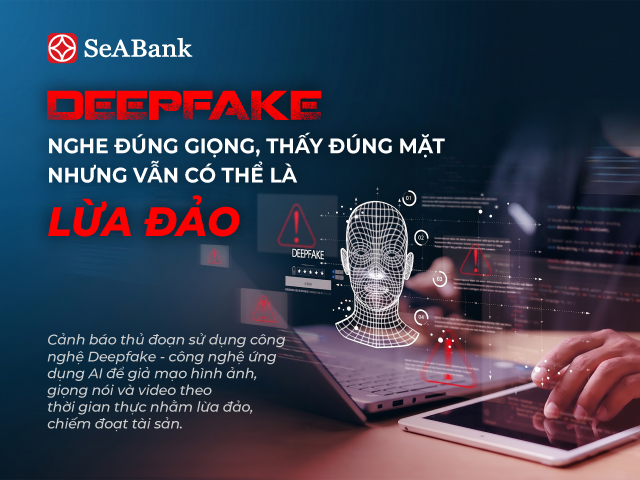
Alert regarding scams and asset misappropriation
In the era of digital transformation and rapid advancement of Artificial Intelligence (AI), technology-enabled fraud schemes have become increasingly sophisticated and difficult to detect. One of the most concerning threats being widely reported currently is the misuse of Deepfake technology—an AI-powered technology capable of replicating images, voices, and videos in real time—to deceive individuals and steal their assets, particularly users of banking and financial services.
26/06/2026
Read more

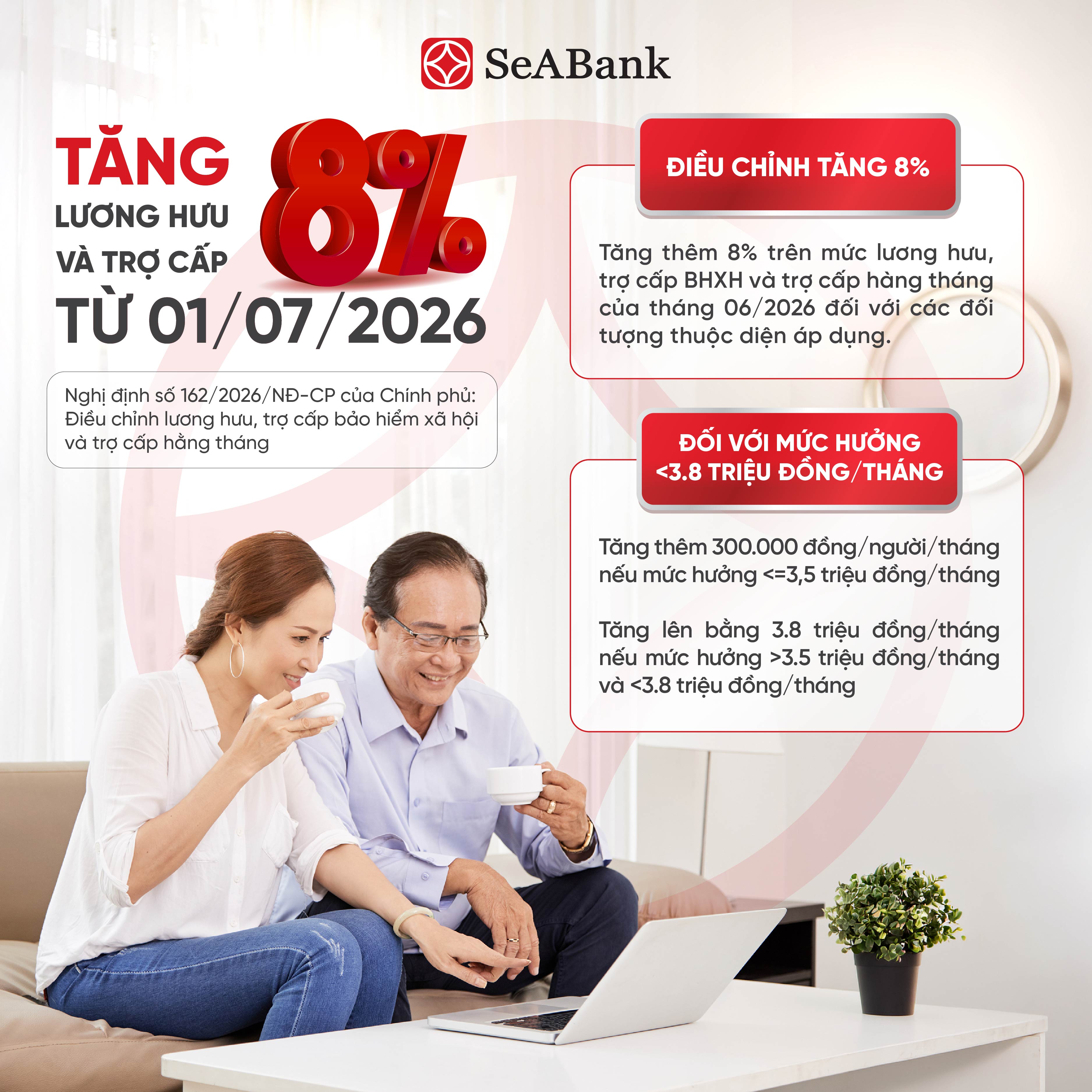
Guidelines for increasing pensions, social insurance benefits, and monthly allowances by 8% from July 1, 2026.
The Minister of Home Affairs issued Circular No. 14/2026/TT-BNV detailing the adjustment of pensions, social insurance benefits, and monthly allowances. Accordingly, from July 1, 2026, pensions, social insurance benefits, and monthly allowances will increase by 8%.
15/06/2026
Read more

Official announcement on the launch of SeABank's outbound telesales channel
With the goal of continuously enhancing service quality, optimizing customer support, and improving customer experience, Southeast Asia Commercial Joint Stock Bank (SeABank) officially announces the launch of its Outbound Telesales Channel.
02/06/2026
Read more