Detailed answers: Can bad debt get a mortgage loan and how to handle it?
11/11/2025
Find out if bad debt can get a mortgage, with conditions, procedures and ways to increase the chance of being approved by the bank.
Many people who have had financial difficulties often wonder "Can bad debt get a mortgage loan?" when you want to borrow money from the bank to buy a house, invest or spend money for personal expenses. In fact, having bad debt does not mean that you will lose the opportunity to borrow money completely, but the approval process will be more strict and depend on the level of debt as well as the policies of each bank. The following article will help you understand the concept of bad debt, how to check and the conditions to still be able to borrow money even if you have or have had bad debt.
Readers note: The data and information in the article are compiled from general market sources and do not apply specifically to SeABank's products or services.
Quick summary:
Bad debt is a loan that the borrower fails to repay on time or is unlikely to repay both principal and interest to the bank. Bad debt is classified into 5 groups according to CIC, in which, group 3 - 5 is the group of debt overdue for more than 90 days, high risk level.
Can bad debt get a mortgage? - Yes, but it depends on the level of bad debt and the bank's policy:
Group 1 & 2 debt: Can still get a mortgage loan due to low risk. But requires valuable collateral, stable income and clear credit history.
Group 3 - 4 - 5 debt: Difficult or almost impossible to borrow, because this is a serious bad debt group. Can only be considered if all old debt has been paid off, a good credit history has been maintained for at least 12 months and there are large, liquid collateral assets when taking out a mortgage loan.
1. Overview of bad debt
1.1. Concept
Bad debt is a loan that the borrower cannot pay on time or is unlikely to be able to repay both principal and interest as committed to the bank.
According to Clause 8, Article 3 Circular 11/2021/TT-NHNN Bad debt includes debt in groups 3, 4 and 5, usually debts that are overdue for more than 90 days or are assessed as difficult to collect. This is an important factor reflecting the credit quality and financial risk of customers.
1.2. Classification according to CIC
CIC (Credit Information Center) – Vietnam National Credit Information Center, is a unit of the State Bank with the function of collecting, storing and providing information on the credit history of individuals and organizations.
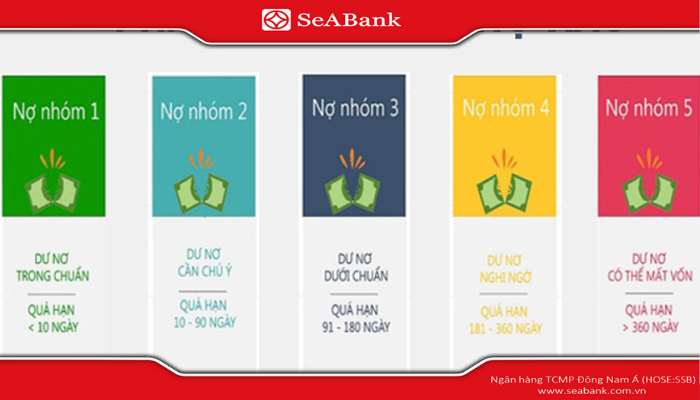
Based on CIC data, customer debt is divided into 5 groups according to risk level Circular 11/2021/TT-NHNN:
Debt group
Characteristics / Classification criteria
Risk level
Group 1 – Standard debt
Customers pay debts on time, no signs of credit risk.
Safe, risk-free
Group 2 – Debts that need attention
Loans that are 10 to less than 90 days past due or show signs of needing further monitoring.
Low risk, need to monitor
Group 3 – Substandard debt
Debts overdue from 91 to 180 days; recovery ability decreases, banks must set aside risk provisions.
Medium risk
Group 4 – Doubtful debt
Debts overdue from 181 to 360 days or showing signs of insolvency.
High risk
Group 5 – Debt with potential loss of capital
Debt overdue for more than 360 days, almost impossible to collect; considered the most serious bad debt.
Very high risk, possible loss of capital
Classification of 5 debt groups according to CIC
1.3. Impact of bad debt
Bad debt not only has a negative impact on banks but also directly affects individuals or businesses that borrow capital. Specifically:
Reduced personal/business creditworthiness: When recorded as bad debt, customers will have difficulty in borrowing capital, opening credit cards or using other financial products.
Increased cost of borrowing: People with bad credit histories are often charged higher interest rates or lower limits when borrowing again.
Impact on personal financial planning: The inability to access new credit makes it difficult for customers to expand their businesses or meet urgent spending needs.
Impact on the banking system: High bad debt ratio reduces liquidity, affects credit activities and the stability of the entire banking industry.
1.4. How to check bad debt
Customers can easily check their personal bad debt through the following official and reliable channels:
Look up on CIC's website or app
Check via banking app
Contact the bank directly where you borrowed.
You can contact the bank to check your debt status and loan ability.
See more: What is CIC? 3+ Ways to look up to check personal credit history
2. Can bad debt get a mortgage loan? Cases of bad debt eligible for a mortgage loan
People with bad debt can still get a mortgage, however the chances of loan approval are very low and depend on many different factors. Banks often carefully review customer profiles to assess credit risk before making lending decisions. The main influencing factors include:
Bad debt level (group) according to CIC classification.
Bad debt duration and processing status (paid or not).
Credit policies of each bank or financial institution.
2.1. Bad debt group 1 and 2: Ability to borrow
For customers in group 1 (standard debt) or group 2 (debt requiring attention), mortgage loans are still possible, because these are the two groups with the lowest risk level in the debt classification system. Banks often consider lending if customers have valuable mortgage assets, a stable source of income and a transparent credit history.
However, to minimize risks, banks can apply higher interest rates, require additional documents proving debt repayment ability or periodically check CIC during the loan period to ensure that customers do not incur new bad debts.
The bank will rely on the above CIC score to approve loan funding.
2.2. Bad debt group 3, 4, 5: Difficult or impossible to borrow
For customers in group 3 (substandard debt), group 4 (doubtful debt) and group 5 (debt with potential loss of capital), the possibility of being approved for a mortgage loan by the bank is almost very low or impossible. These are serious bad debt groups, reflecting high risks in capital recovery, so most banks will reject loan applications to ensure credit safety.
However, in some special cases, customers can still be considered if they have paid off all old debts, have a debt clearance certificate, maintain a good credit history for at least 12-24 months and own valuable, liquid collateral. These factors will help the bank reconsider the application with a higher level of caution.
3. Conditions and procedures for mortgage loans when having bad debt
3.1. Conditions
To be approved for a loan, customers need to ensure the following basic conditions:
All bad debts have been settled and have a confirmation from the bank or credit institution before.
The time after bad debt settlement is long enough – It usually takes at least 12 to 24 months for CIC to update and delete bad debt history from the system.
Have valuable and highly liquid collateral, such as real estate, cars, savings books, or other secured assets.
A stable source of income can be proven through salary statements, employment contracts, business revenue or other legal documents.
No new overdue debt arises, and credit history after settlement must be maintained well.
In accordance with the credit policy of each bank, because each unit has its own regulations on risk acceptance level.
Each bank has its own lending conditions.
3.2. Procedures
When meeting the necessary conditions, customers need to prepare mortgage loan documents including:
Personal documents: ID card/CCCD, household registration book, marriage certificate or confirmation of single status.
Proof of income: Salary statement of the last 3-6 months, labor contract or financial report (for business households and enterprises).
Mortgage documents: Red book, pink book, vehicle registration or savings book in the borrower's name.
Certificate of bad debt settlement (if any): This is an important factor that helps banks consider the possibility of approving the application.
Loan application and repayment plan: Clearly state the loan purpose, usage plan and specific repayment source.
If you meet all the conditions and demonstrate your ability to repay the loan, the loan can still be approved, even if your credit history has bad debt.
4. 5+ Notes on mortgage loans when having bad debt
Applying for a mortgage when you have a bad credit history is a rather sensitive process, requiring customers to carefully prepare their documents, finances and credit information. To increase the likelihood of approval, borrowers should note some important points below.
Prioritize banks with flexible policies or loan support for customers with bad debt group 1-2.
Contact a consultant via the hotline or credit specialist to get detailed advice on loan conditions, avoiding direct rejection at the counter.
Providing honest, clear and transparent records of income, assets and financial commitments will create a positive impression with the appraisal department.
Use employment contracts, payroll, lease agreements, business income, etc. to prove your ability to repay the loan.
If you have paid off your bad debt, make sure CIC is updated with this information so that your application can be reviewed more objectively.
Pay off all outstanding debt and accrued interest as soon as possible.
Check CIC periodically to confirm debt status.
Maintain credit by paying off existing loans on time.
Avoid opening new loans while bad debt is being resolved.
You should choose a reputable bank to borrow capital.
5. Frequently Asked Questions
1. Does bad debt affect relatives?
No. Bad debt only affects the individual or organization whose name is on the loan, not relatives or other family members, unless they co-sign the loan contract.
2. Can someone with bad debt in the household register get a loan?
It is possible to get a loan. The bank only considers the credit history of the borrower, not the household registration. However, if the bad debtor is a co-owner of the mortgaged property, the application may be examined more closely.
3. What to do if your loan application is rejected?
If your application is rejected, you should contact the credit specialist directly to find out the reason, then complete the application or wait for enough time to clear the bad debt on CIC before re-submitting. In addition, you can choose a bank with a more flexible policy for customers who have had bad debt in the light group (group 1-2).
6. Quick and simple loans at SeABank
SeABank (Southeast Asia Commercial Joint Stock Bank) is one of the leading prestigious commercial banks in Vietnam. With a strong financial foundation and modern technology system, SeABank provides a variety of credit products, helping customers access capital quickly, flexibly and safely. SeABank offers many loan methods, meeting the needs of consumers or businesses needing capital for business:
Unsecured loans: No collateral required, suitable for people with stable income from salary or personal business. Simple profile, quick approval time, limit can be up to 500 million VND.
Mortgage loans: For customers with collateral such as houses, land, cars or savings books. Loans have large limits, preferential interest rates and flexible repayment periods. Suitable for purposes such as buying a house, repairing a house, investing in business or making large expenses.
Business loans: Supporting business households, small businesses and self-employed individuals who want to expand production activities. SeABank provides diverse credit limits, long loan terms, and competitive interest rate policies to help customers easily turn around capital and develop sustainably.
In addition, SeABank always aims for the fastest and simplest loan experience for customers. To register for a loan, you only need:
Personal documents: ID card/CCCD, household registration, marriage certificate or confirmation of single status.
Proof of income: Employment contract, salary statement of the last 3-6 months, or business revenue documents.
Documents on collateral (if any): Red book, pink book, vehicle registration, savings book or life insurance contract.
The application will be quickly assessed and approved in a short time, helping customers access capital effectively and transparently.
When choosing to borrow capital at SeABank, customers will enjoy many outstanding benefits compared to other banks:
Simple procedures, quick disbursement: The loan process is shortened, helping customers receive capital after just a few working days.
Competitive and flexible interest rates: SeABank regularly implements attractive interest rate incentive programs for both unsecured and mortgage loans.
High loan limit:Meet a variety of needs – from personal spending, buying a house, buying a car to expanding business.
Flexible loan terms: Term up to 25 years (for mortgages), helping customers easily balance cash flow.
Dedicated consulting support: SeABank's team of experts always accompanies and advises on the most suitable loan options for each customer's financial capacity.
Modern digital technology: Customers can look up, manage and pay loans easily via the SeAMobile application or the SeANet system without having to go to the counter.
In short, to answer the question "Can bad debt get a mortgage loan?" need to consider each specific case. People with bad debt can still be considered for loans if they can prove their financial stability, have completely resolved their debt and have valid collateral. More importantly, you should regularly check CIC, maintain a good credit history and choose a bank with flexible policies to get maximum support during the loan process.
If youIf you want to learn more about SeABank's loan products, you can contact the nearest transaction point or call Hotline 1900 555 587 or visit the website www.seabank.com.vn for more details.
Southeast Asia Commercial Joint Stock Bank SeABank

 11/11/2025