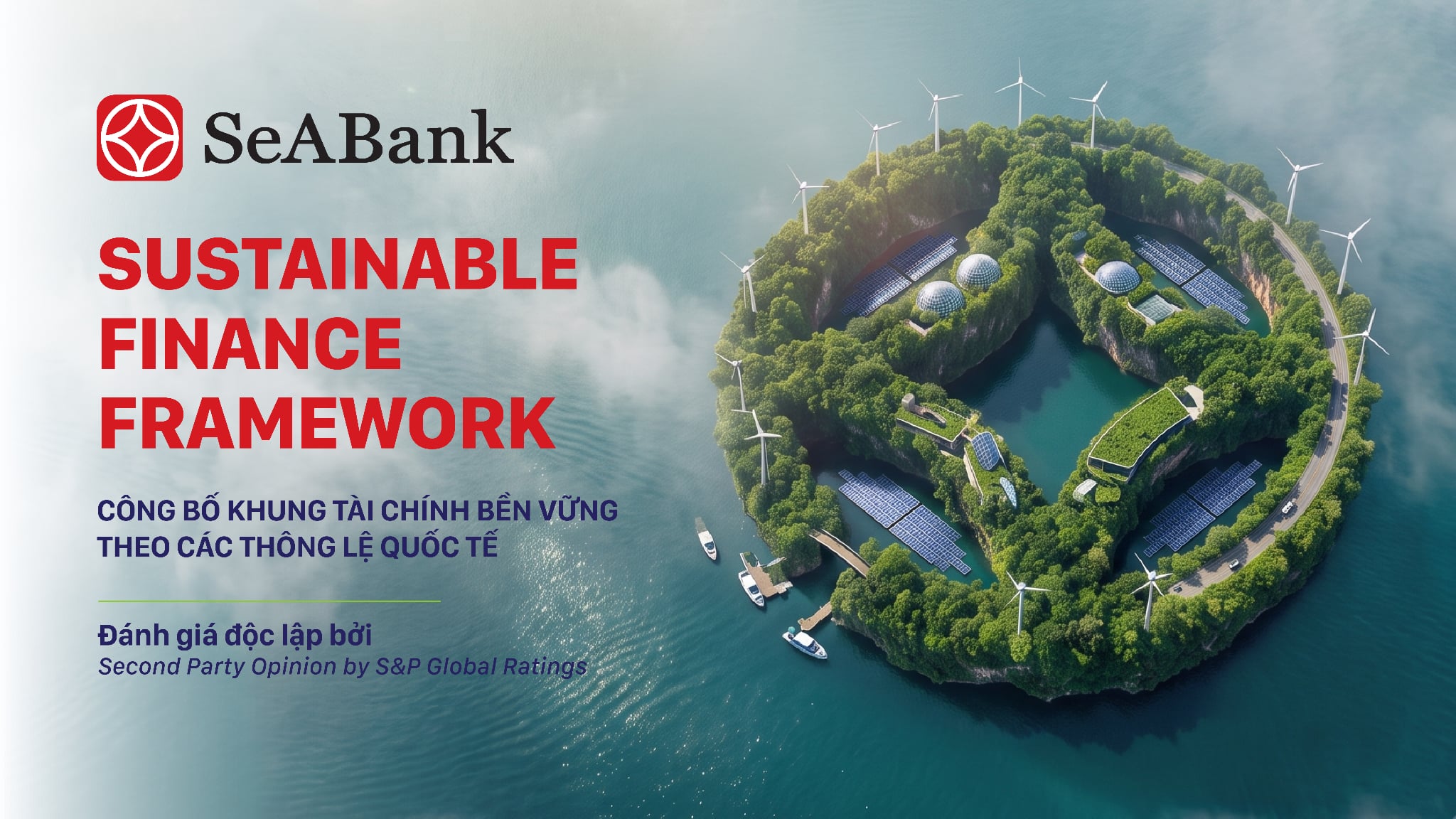
Southeast Asia Commercial Joint Stock Bank (SeABank, HOSE: SSB) has officially announced its Sustainable Finance Framework, which received a Second-Party Opinion (SPO) from S&P Global Ratings on September 24, 2026. The Framework provides a basis for SeABank to expand sustainable funding and allocate capital more effectively towards its sustainability commitments.
As Vietnam works toward net-zero emissions by 2050 and implements the National Green Growth Strategy, credit institutions play a dual role: supplying capital to the economy and directing capital flows toward sectors that deliver environmental and social benefits. To ensure capital is allocated efficiently and transparently in line with the Government’s sustainable development orientation (Decision No. 841/QD-TTg dated July 14, 2023 of the Prime Minister on the Roadmap for implementing the 17 Sustainable Development Goals to 2030) and the National Green Growth Strategy for 2021-2030, with a vision to 2050 (Decision No. 1658/QD-TTg of the Prime Minister), SeABank is progressively integrating its sustainable development strategy into the Bank’s overall strategy, while standardizing its credit criteria, appraisal procedures, and reporting mechanisms.
Directing capital flows through a sustainable framework
SeABank’s Sustainable Finance Framework is designed as a tool to guide the mobilization and allocation of sustainable funding. It is aligned with 6 international principles and guidelines issued by the International Capital Market Association (ICMA), the Loan Market Association (LMA) and Asia Pacific Loan Market Association (APLMA), the Loan Syndications and Trading Association (LSTA), and the International Finance Corporation (IFC). Second Party Opinion (SPO) by S&P Global Ratings was announced on September 24, 2026.
The Framework covers the entire lifecycle of funds through four core steps: use of proceeds, project evaluation and selection, management of proceeds and allocation reporting, annual impact reporting. Proceeds are expected to be allocated to eligible projects under three financing pillars: 40-45% to 14 green categories, 10-15% to 7 blue categories, and 40-45% to 5 social objectives.
\These project groups help address environmental and social challenges in Vietnam, such as reducing greenhouse gas emissions, easing pressure on water resources, and tackling waste and pollution. They also expand access to infrastructure, essential services, housing, and finance for target groups in society. In the blue sector, projects deliver benefits for marine biodiversity and ecosystems.
To ensure funds are allocated effectively and in line with the Sustainable Finance Framework’s objectives, a number of specific quantitative criteria was set out, such as a minimum 20% improvement in energy savings, emissions reduction, or water use reduction. All credit applications are screened through the Environmental and Social Management System (ESMS), with an exclusion list covering activities related to fossil fuels, coal, deforestation, and others.
The issuance of the Sustainable Finance Framework further standardizes the allocation of funds according to eligibility criteria, and strengthens transparency through annual reporting. It is a step toward ensuring funds are used for their intended purposes and generate positive impact for the community, making sustainable finance an integral part of the Bank’s operations.
Building on a long-term sustainability journey
The Sustainable Finance Framework is not an isolated initiative, but rather a continuation of SeABank’s efforts over the years to establish a foundation for sustainable finance. With the aim of making sustainable finance a core capability, the Bank has been progressively integrating ESG considerations into its strategy, operations and capital allocation procedures.
Sustainable Finance Framework is an important milestone on SeABank's sustainability journey.
In 2025, SeABank introduced its Green and Blue Bond Framework, aligned with ICMA principles and rated “Medium Green” by S&P Global Ratings, the second-highest rating on the six-level Shades of Green scale that assesses the environmental credentials of investments, projects and their contributions to climate change mitigation. This framework laid the groundwork for SeABank’s Sustainable Finance Framework, which builds on established green finance criteria and mechanisms while expanding the scope to include lending and social factors, thereby bringing the green, blue, and social categories into a single, unified framework.
These efforts have translated into tangible resources, with nearly US$1.1 billion mobilized from reputable international financial institutions, including IFC, AIIB, Norfund, Proparco, FMO and DFC, to support inclusive and sustainable finance. As of the end of September 2026, SeABank’s outstanding green credit exceeded VND4.1 trillion, up more than 150% from the end of 2025, concentrated in sectors such as green transportation, energy efficiency, and climate-smart agriculture.
Building on these resources and initial achievements, SeABank continues to advance its sustainability strategy, working towards specific, measurable targets for 2030: green credit accounting for 5% of total outstanding loans; a 10% reduction in greenhouse gas emissions against the baseline year; and expanded financial access for vulnerable groups, women-owned businesses, and micro, small and medium-sized enterprises (MSMEs).
“For SeABank, sustainable development is a guiding principle that runs throughout our development strategy. The Sustainable Finance Framework marks a step forward on this journey, creating a unified foundation for us to mobilize and allocate capital, accompany our customers through their transition, and pursue lasting sustainable value for the economy and the community,” said Mr. Nguyen Tuan Anh, Deputy CEO of SeABank.
With the Sustainable Finance Framework, SeABank has a stronger basis to expand funding for green, blue, and social sectors, while enhancing transparency and the ability to measure the impact of capital flows. In doing so, the Bank continues to play its role as a financial bridge, accompanying customers and creating lasting value while contributing to a more sustainable and inclusive economy.
Customers and partners can refer to the following documents:
Sustainable Finance Framework – available here. S&P Global Second-Party Opinion – available here. Green and Blue Bond Framework (published in 2025) – available here.